The Friends Who Did Not Match
For the grown-up reading along
Ember is a storybook guardian, not a wildlife lesson in disguise, and the book keeps the real-world rules intact anyway: every visit happens with a grown-up, at a distance the kingdom's animal keeper set, with no touching, no feeding, and every approach left to the animal. If your child meets real wildlife, the family rule is the same one the King models: stop, stay with your grown-up, and watch from far away; and real axolotls, like all wild water creatures, stay in their water. The friendship strategy underneath is concrete and copyable for the playground as much as the spring: stop trying to match, find the one real thing you share, and arrange a when and a where. Allison's failed SAME column normalizes a first plan that does not work, and the storm night shows the payoff arriving on its own once the meeting has been made. Distance is drawn as respect throughout, never as fear, and the lonely post nobody visits is treated as a job description, not a warning.
The Friends Who Did Not Match, in full
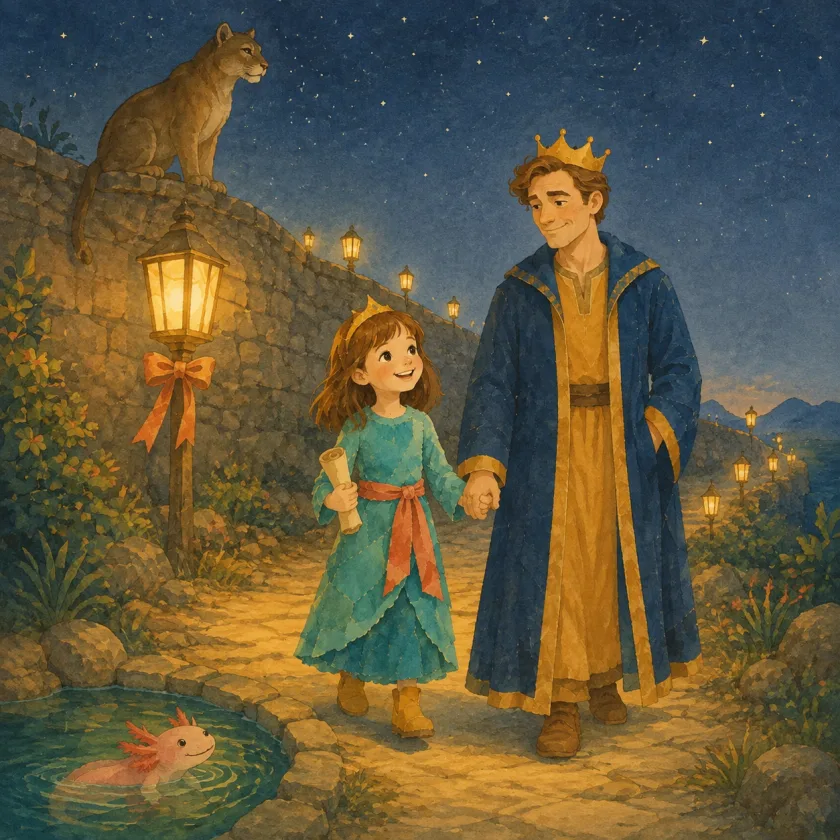
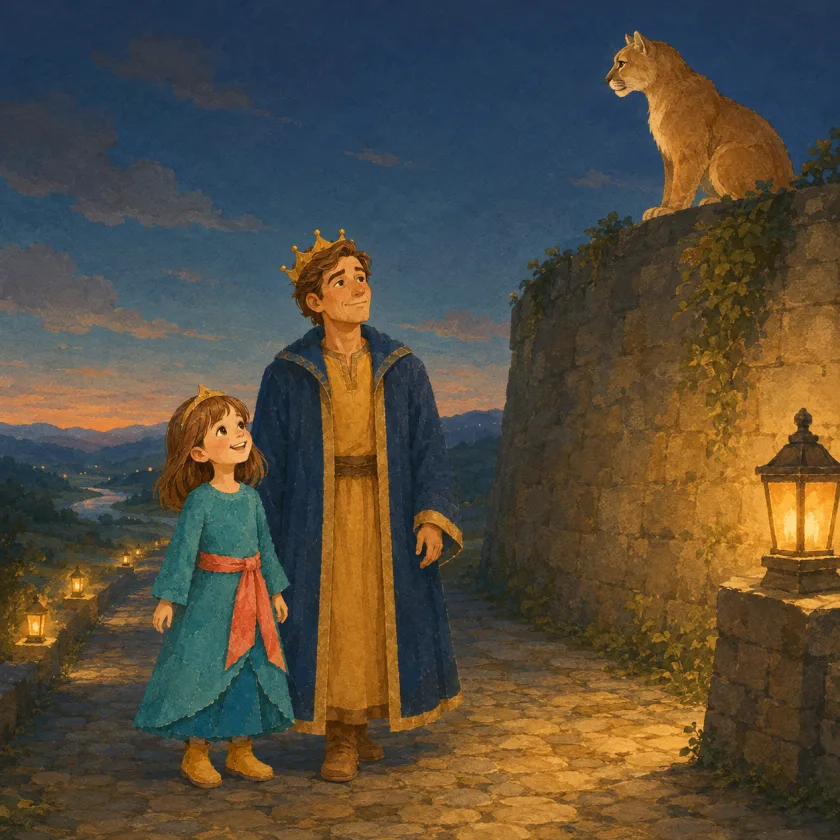
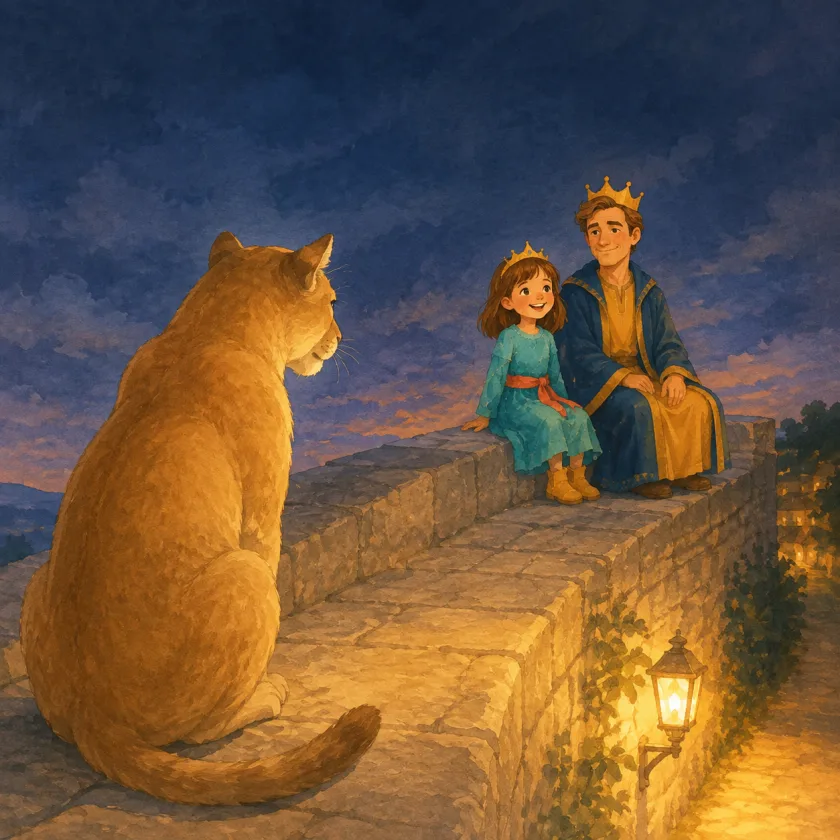
At the high end of the lantern road there is an old stone wall, and on the old stone wall there is a cougar.
His name is Ember. He is the color of the last hour of afternoon, and he is big the way the wall is big. Every dusk he watches the road until morning, and everyone in the kingdom walks a little faster under that wall.
Everyone except Princess Allison, who stopped. Her father, the King, stopped beside her.
Ember's tail-tip ticked once, like a clock finding its next second.
"He is not mean," said Allison. "He is on duty."
The stories about Ember were the hurrying kind. The facts were better.
"He has kept the high road since before you were born," said the King. "The keeper who minds our wild neighbors gives us the rules of that wall. Visit the far end only, bring nothing to feed him, touch nothing, and let him decide every step closer."
"Does anybody visit?" asked Allison.
"No," said the King. He looked up at the wall for a long moment. "Nobody has ever sat at the far end of it. Keeping watch is a job you mostly do alone."
The next evening she went looking for a friend for Ember, the King beside her, and found the spring below the wall. In the middle of it was an axolotl, coral-pink and no bigger than her palm.
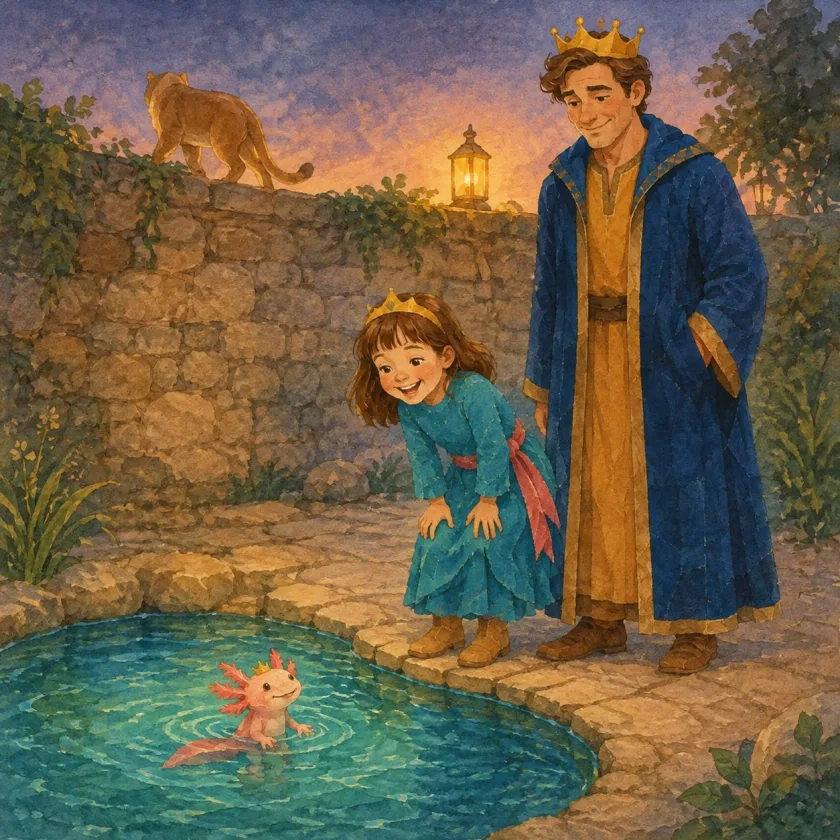
"You were born already wearing a crown," said Allison, bending down at the water's edge, hands to herself, as you do with royalty.
This was Brook, who smiled the way axolotls smile, which is always, feathered gills lifting and settling in the water.
Then Brook looked up, past her, at the wall. Along its top walked the great gold keeper, his back to them both.
Twenty steps, wall to water.
That night Allison took a fresh sheet of paper and her backup orange crayon and made two columns. SAME, said one. DIFFERENT, said the other.
DIFFERENT filled up like a rain barrel. One naps in snowdrifts. One lives in a spring the size of a soup pot. One has whiskers like broom straws. One has not a single whisker.
SAME stayed empty. Allison tapped it with the crayon, in case it was shy. It stayed empty.
"An empty column is not a no," Allison decided, out loud, so it would be true. "It is a not yet."
She folded the paper down the middle and put it in her pocket, and DIFFERENT did not get one more line.
Every evening that week, she and the King climbed up and sat at the far end of the wall, and watched the road the way Ember watched it. They did not bring so much as a crumb. They brought the one thing the rules let through.
Company.
The first evening, his tail-tip stopped. The second and third, it stayed stopped, and they stayed anyway. On the fourth, the gold shoulder rose and moved one whole cat-length closer along the top of the wall, and not one stone shifted under him.
"We are being introduced," whispered Allison, "at his speed."
"Where does Ember drink?" Allison asked on the walk home.
"At the spring, at first light," said the King. "Every keeper's secret hour."
"Dusk and dawn," said Allison. "Brook watches the wall all evening. Ember watches the road all night. And at dawn he comes down to the spring." She stopped walking. "I wonder if Brook is awake then. We could watch from the path."
She turned the paper over right there on the road and wrote two new questions on the back. WHEN? WHERE?
"Somebody has to introduce the hours," she said.
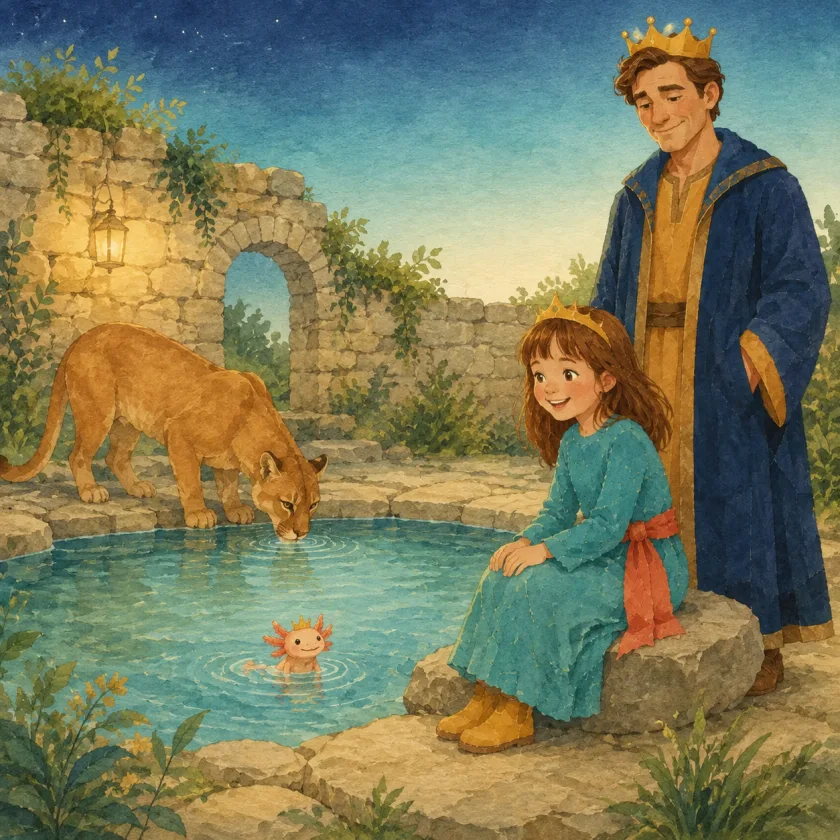
She and the King came to the spring at first light. Brook was still beneath a frond. Then the small crown stirred and turned toward the path. They took their place a courteous distance away and waited.
Down the hill, huge and quiet as the last of the night, came Ember.
He paused, reading the morning. They did not move, and let the rules say hello for them. So he came on, and lowered his heavy head to the spring, and drank.
And came up nose to crown with Brook.
Neither one moved. Ember's ears came forward. The water between them went smooth, and stayed smooth, for one long breath.
Ember's tail-tip ticked. Brook stayed near the surface, watching with him. Allison turned her paper back to the two columns and wrote the first line in SAME. KEEPS WATCH.
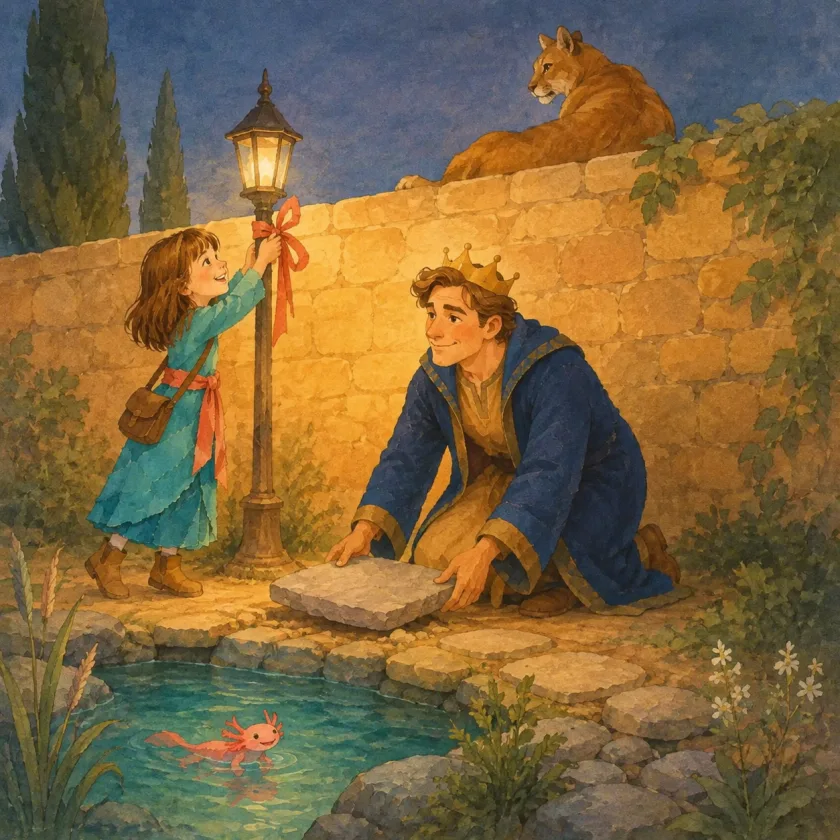
Making a visiting place took one more evening. A flat grey stone lay by the path, the exact shape of a sitting stone. Allison chose its place, at the courteous distance beside the spring, and the King moved it there. Then she stretched up on tiptoe and tied a coral ribbon to the lantern post above.
"The princess has a reason," said the King.
"Two reasons," said Allison. "One as big as the wall. One as small as my palm."
Dusk at the wall with Ember, his tail-tip ticking. Dawn at the spring, with Allison and the King on the flat grey stone and Brook watching from the water. The front of her paper gained three more things in SAME: THE SPRING. QUIET COMPANY. US.
The squall came at dusk, wind first and then rain with its sleeves rolled up. It took the last lantern's flame in one gust. Allison watched from her window with her forehead on the cold glass and both hands flat on the sill. She was thinking about the dark road, and the keeper keeping it alone.
In the morning she and the King walked up and read the mud from the path. Ember's wide prints led down to the spring and stopped at a hollow in the grass, the kind you make by staying all night. He was still there, resting on the bank. Brook hovered near the surface beside him.
"Two friends," said Allison. "Same storm."
The King relit the last lantern that evening. The wall above held its keeper, the spring below its crown, the coral ribbon shining on the post between.
"I thought friends had to match," Allison said on the road home, tilting the paper into the lantern light. "Four things in SAME. Forty in DIFFERENT."
On the wall, a tail-tip ticked goodnight.
"The forty are just whiskers," said the King. "Dawn, then. Bring your crayon."
Below the wall, the water held one small point of lantern light. Above it, in the dark, an ear turned toward the road.