The Frost Before Breakfast
For the grown-up reading along
Mom's nightly sky check is a real, copyable family ritual: step out together before bed, dressed warm, and read three things, clear, still, and cold. The weather in this book behaves the way weather behaves: frost forms on clear calm cold nights and melts in the first sun, and snow arrives under low soft clouds, so the practice the book teaches is watching, not magic. The freezer experiment is deliberately allowed to run: Allison's idea is treated as a real question, the result is examined together, and the lesson arrives from the evidence rather than from a lecture. Cold-morning safety is modeled as ordinary competence: coats over pajamas, checked mittens, a grown-up first on the slippery steps, a hand for the rail, and back inside for breakfast. The before-dawn wake is saved for the rare firsts, the year's first frost and its first snow; on an ordinary yes morning the frost is usually still there at the family's normal waking time, so the practice does not have to cost sleep. Nothing icy is ever walked on, only frosty grass, and the one cup of ice in the book is Allison's own experiment, looked at together and never tasted. Miami is named as Mom's real childhood the way the family tells it; the art depicts no real places. The first frost and the first snow stay plain weather rather than occasions: no countdowns, no staging, just a parent who checked the sky and a girl who got to be there. And the ending's reversal is the point of the practice: a child who has been caught for enough mornings will one day do the catching back.
The Frost Before Breakfast, in full
On an ordinary night at the cold end of fall, Allison went up to bed, and the fourth stair creaked under her foot the way it always did.
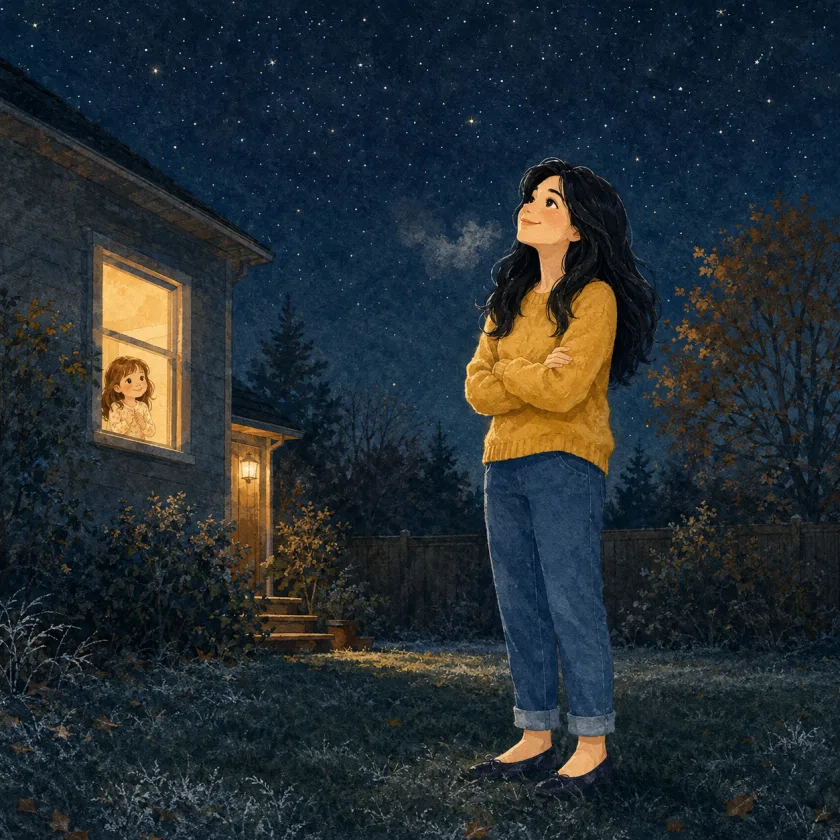
But on her way past the window she stopped. Out in the yard, in the last of the porch light, stood Mom, doing nothing at all. Her face was turned up, the way you look when somebody important is talking.
Mom smiled her porch smile. Allison pressed her nose to the glass until it went white. Outside, the porch light clicked off, and Mom's hand found the rail.
Morning arrived before the sun did.
"Allison." Mom's hand was warm on her shoulder. "It is tomorrow."
"It is today," said Allison into her pillow, because it was too early for riddles.
"It is both," said Mom. "Something happened in the yard while you slept, and the sun is coming to take it back before breakfast."
They dressed fast, coats over pajamas, the official uniform of urgent mornings. Mittens on, a zipper checked to the chin.
At the back door Mom stopped. "The steps will be slippery. I go first. You take the rail."
She opened the door, and the cold came in to meet them and took the warm right off Allison's cheeks.
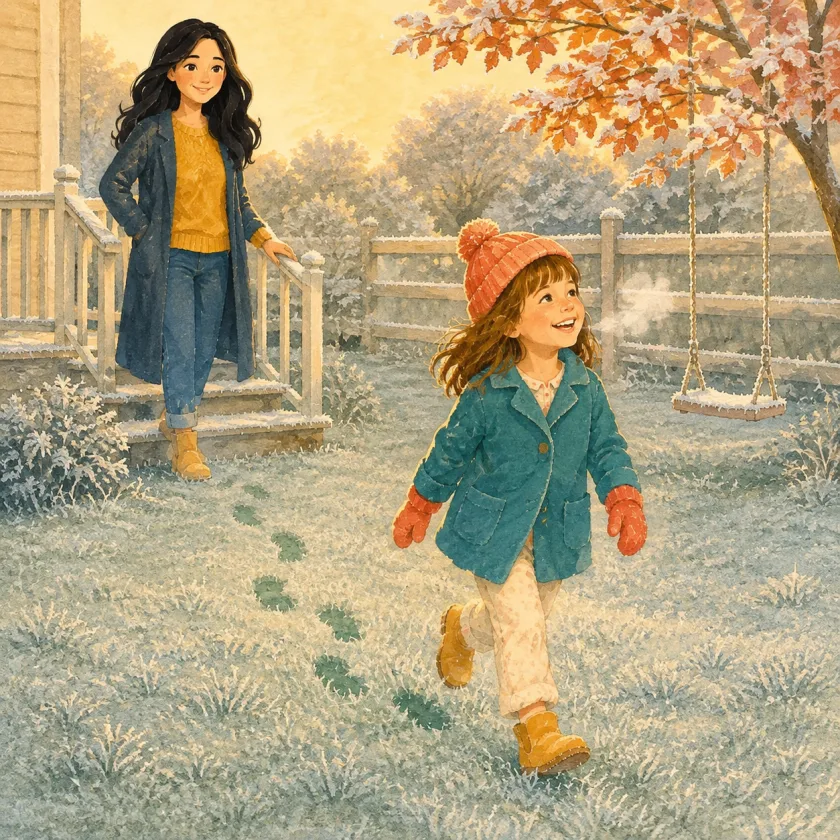
The yard had turned silver.
Every blade of grass wore a thin white coat. The fence rails had grown fur overnight. On the swing, a cushion nobody could sit on.
Allison stopped on the bottom step, one boot down and the other still in the air, and forgot to breathe out.
"Frost," said Mom, one hand on the rail. "The first one this year. Go on."
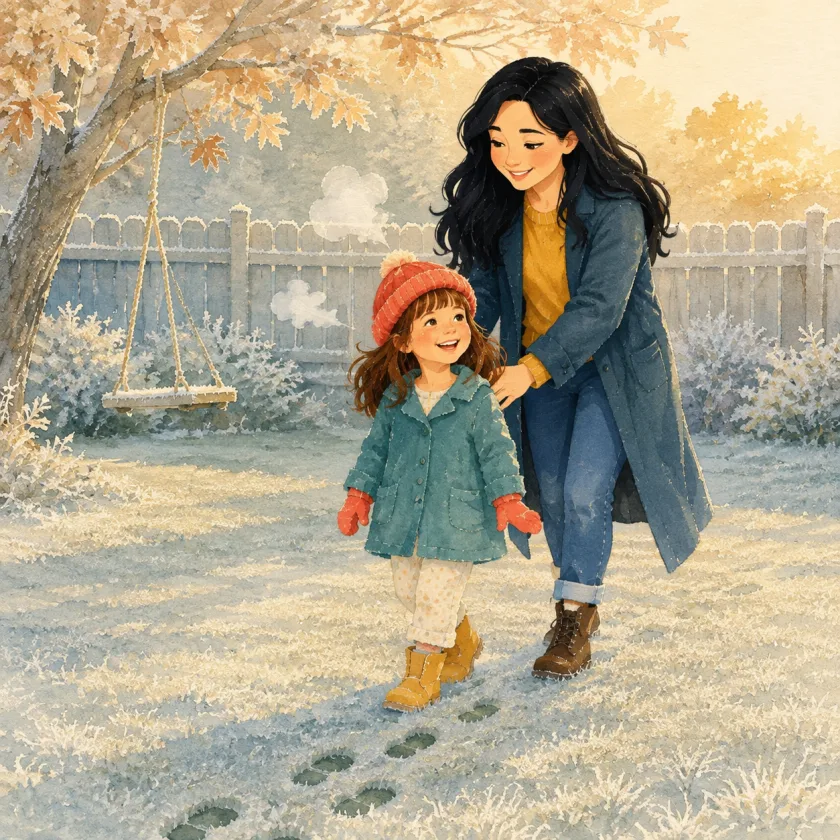
So Allison walked out into the silver, crunch, crunch, crunch, and every footstep turned dark green behind her, as if her boots were writing on the morning. Her laugh came out as a little white cloud.
Allison pulled off one mitten and touched a blade of grass, quick as a question. The white on it turned into a bead of water.
"It melted," she said, surprised at her own finger.
"Warm hands," said Mom. "Frost has no defense against them." She held out the mitten, and Allison put it back on.
Allison went along the fence, and at the corner post she stopped.
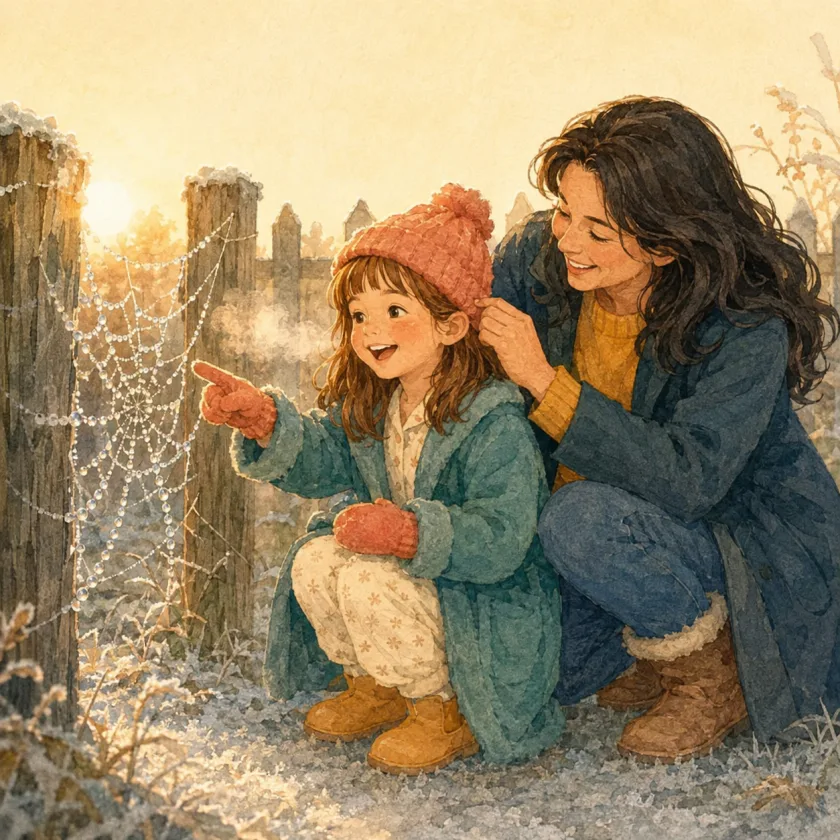
A spider's web hung between two posts, and the frost had found that too. Every thread was strung with beads too small to count, a chandelier the size of her hand.
They crouched in front of it, side by side, and Allison pointed. "Have you been waiting for this?"
"When I was your size," said Mom, "I lived in a city called Miami, where I never saw frost. I read about it in a library book. Grass made of sugar. A morning you could crunch. It sounded made up."
"So I promised myself," she said. "Someday somebody I loved would stand in a real one." She tucked a loose bit of hair back under Allison's hat.
"I saw you from my window last night," said Allison. "How did you know to look for frost?"
"Caught," said Mom. "I was asking the sky. Clouds are a no. Wind is a no. Clear, still, and cold: three yeses make a frost." She pulled her coat closed. "Mostly it is noes. I ask anyway."
"Can I learn it? The asking?"
"You just did the hardest part," said Mom. "You wanted to."
Then the sun put a gold line along the fence.
"Ah," said Mom. "Here comes the taking-back."
The yard un-silvered. Wherever the light landed the frost let go, the fence fur first, then the grass.
"Wait," Allison said, to the sun, which did not.
She scooped a pinch of frosted grass from the last white corner and went up the steps, one hand on the rail and the other in a fist. The storm door banged. The kitchen was warm, and already the pinch was going wet in her hand. Quick, into a cup. A little water to cover it. Into the freezer, where cold things keep. "I am keeping it," she said.
Mom stamped the cold off her boots in the doorway. "We will see," she said, which was not a no.
They had breakfast, because even silver mornings end in oatmeal: warm bowls, mittens drying by the door.
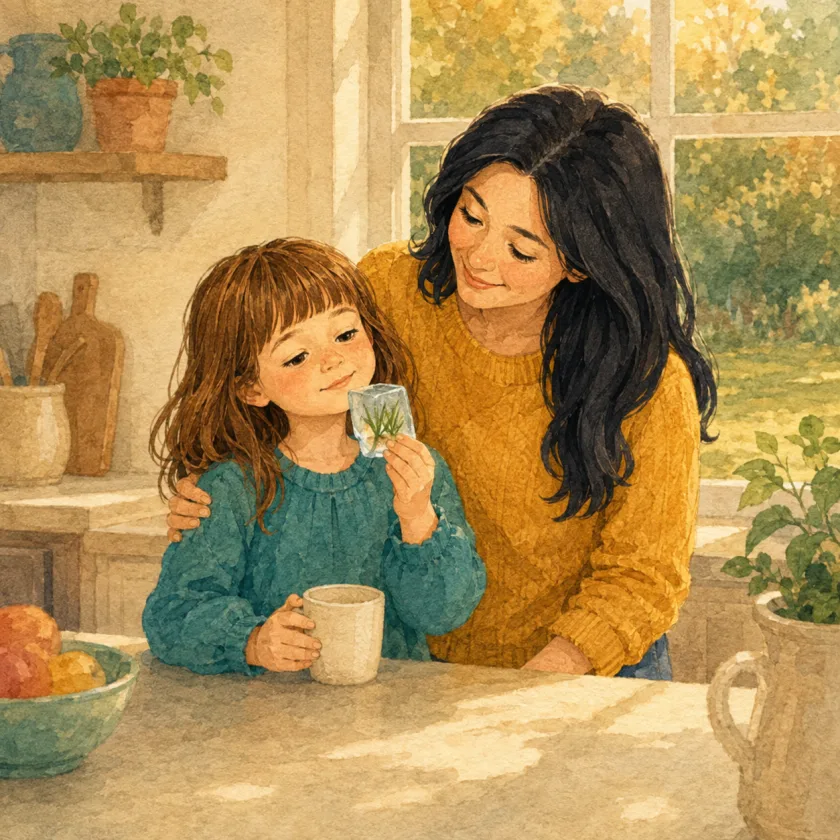
That afternoon Allison took her cup from the freezer. Inside was plain cloudy ice with a little tuft of grass in it.
"It kept the cold," said Allison. "But it did not keep the it."
"No," said Mom, one arm around her. "The cold keeps. The morning does not. Freezers are good at winter and no good at all at mornings."
"Then how do you keep one?"
"You were in it," said Mom. "A morning will not go into a cup. It goes into a girl standing in the yard when it happens."
Now the asking belonged to both of them. Every night, in coats over pajamas, they went out and asked the sky. Most nights it said no: wind in the maple, or clouds over the stars. Allison did not like the noes. She asked anyway. On the clear nights she counted out loud. Sharp stars, one yes. The bare maple holding still, two. Her own breath white in the air, three.
One night there were no stars at all. The clouds had come down low and soft.
"No stars," said Allison. "That is a no."
Mom looked at the sky a long time and smiled her porch smile.
"That," she said, "is a different yes."
Allison woke early. The light on her ceiling was wrong, too white and too soft, and the road outside made no sound. She put a palm flat against the window glass. Then she was running.
"Mom." She put a hand on Mom's shoulder, and the hand was cold from the glass. "It is tomorrow." And Mom, smiling before her eyes were even open, said, "It is both."
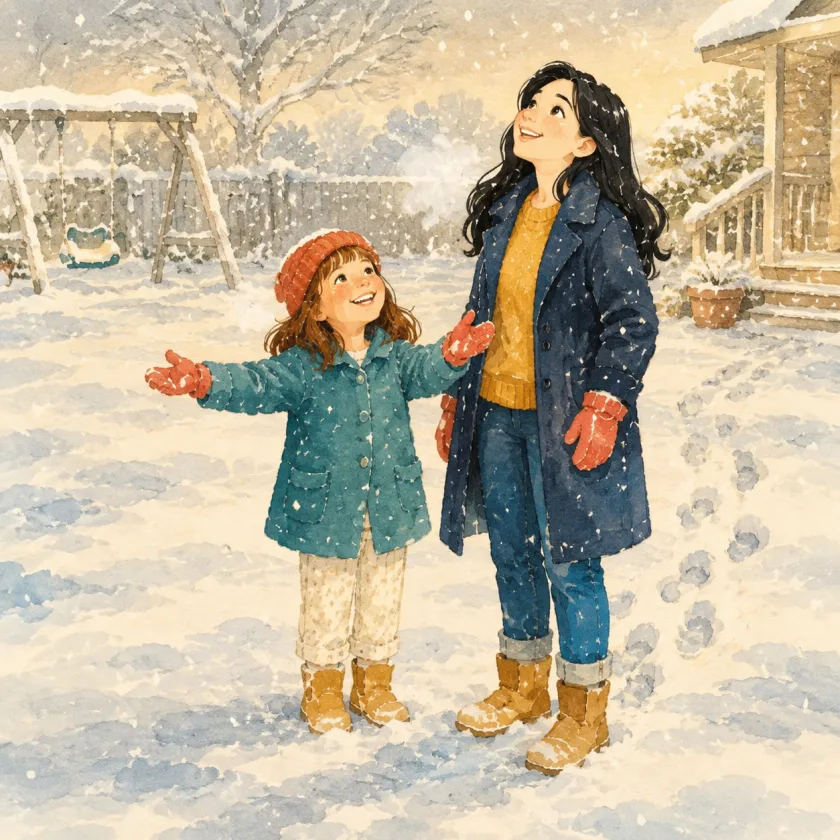
The first snow was falling, fat and slow, and the swing already had a white seat. The fence line was going, post by post. They stood in it, coats over pajamas, catching flakes on their mittens, and under their boots there was no crunch at all.
A flake came down on Allison's mitten and stayed there, whole, every arm of it showing. Up at the house the porch light was still burning from last night's asking.
Mom stood with her face turned up, snow landing on her eyelashes and not melting yet.
Overhead, the sky went on saying yes.