Room on the Map
For the grown-up reading along
Allison's first instinct, handing over her finished map, is treated as genuinely kind and genuinely insufficient, so a child hears that a clumsy first try at welcoming is normal and fixable, not shameful. The working strategy is concrete and copyable: ask the new kid for real help, share a material, walk the space together, and let them add themselves rather than being added. Alder's competence is real (he corrects Allison's map before he ever needs rescuing), modeling that newcomers bring things rather than only needing things. Adults keep every doorway: Queen Marigold receives and releases by name, Alder is met by his own grown-up before the King's pickup happens, and the lesson is delivered by a teacher who is delighted, never scolding. Missing your mountain, like missing your harbor, stays legitimate weather.
Room on the Map, in full
By the second week of school, Princess Allison's map hung on her bedroom wall, one strip of tape at each corner, the orange crayon laid on thick. The fountain sat in the middle, three small figures on its lip. The right side of the paper was still bare, on purpose.
That morning she rolled the map into her satchel to show Professor Fig. She came through the classroom door, satchel swinging, coral ribbon bright, and stopped.
Eleven desks had become twelve overnight. Everybody else had been here a week. The new desk stood by the map shelf, one blank sheet on it, no name card, the chair pushed in square.
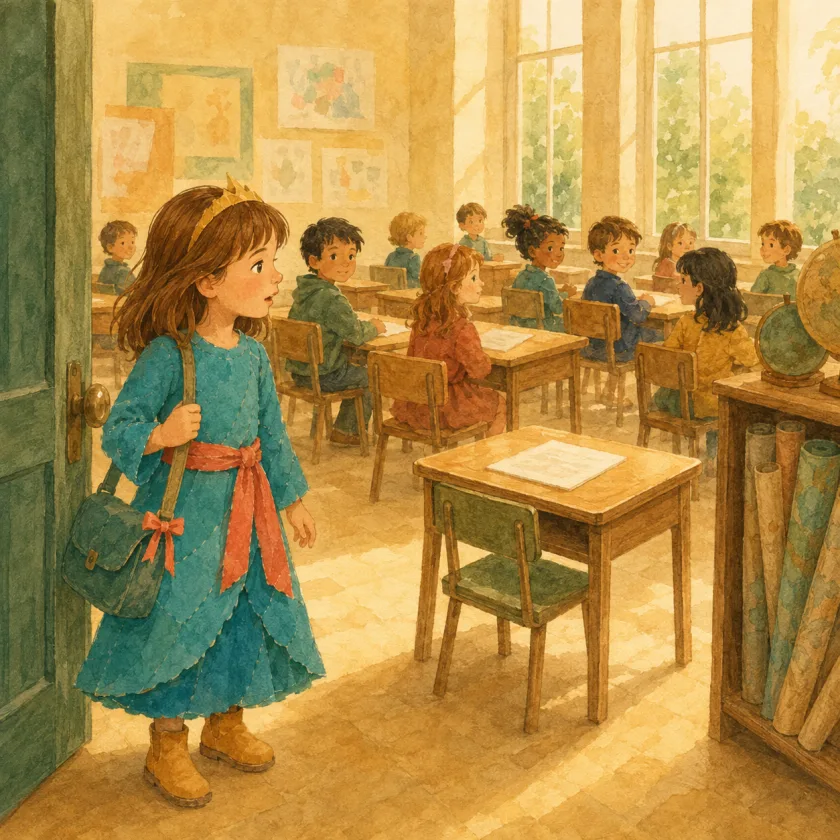
He arrived one step behind Queen Marigold, holding a rolled paper. She kept her hand on the door and said his name as if she had known it for years. "This is Prince Alder, from a mountain kingdom with more goats than people."
Alder looked at the maps on the shelf beside his desk, and his shoulders came down half an inch.
Juniper reached him first, and her voice got there before she did. "I am Juniper! That is Allison, she has maps."
"Thank you," said Alder, and sat down at the twelfth desk and held his rolled paper all morning.
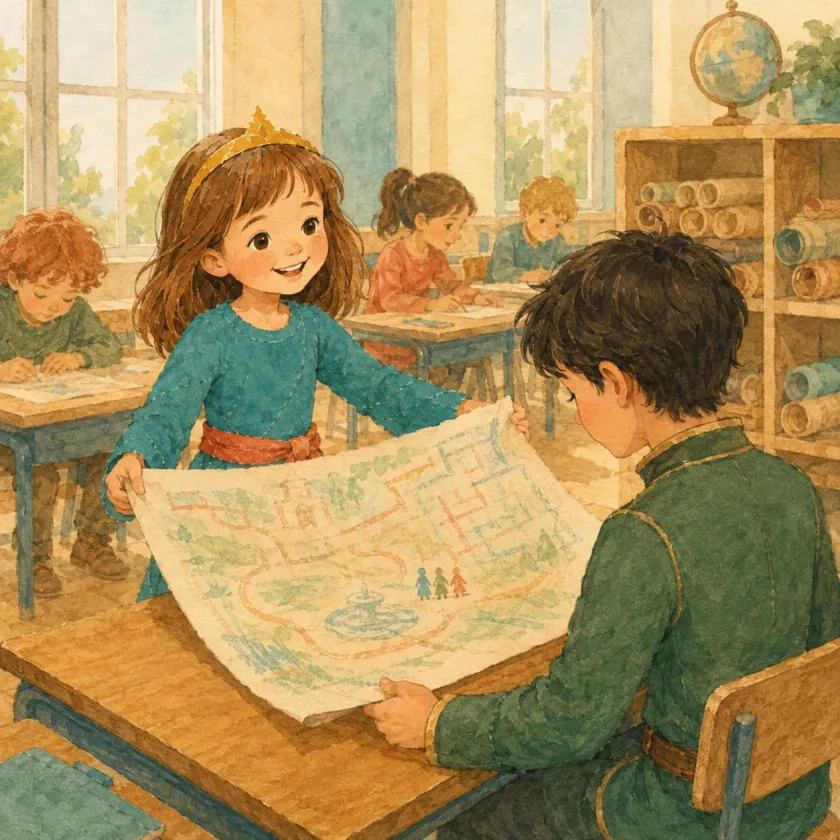
Allison knew that hold. At the morning break she unrolled her own map across his desk, corner to corner, and flattened it with both hands.
"This is the whole school. Here is the map room, and here is the fountain where we sit. You can have it, and then you will know everything."
Alder took it in both hands and read it a long time, and did not say thank you yet.
Because there on the paper was the fountain, three small figures on its lip, and none of them was him.
"Thank you," he said, quieter. Her map stayed open across his desk until the bell, and neither of them touched it. Allison waited for the smile. It did not come.
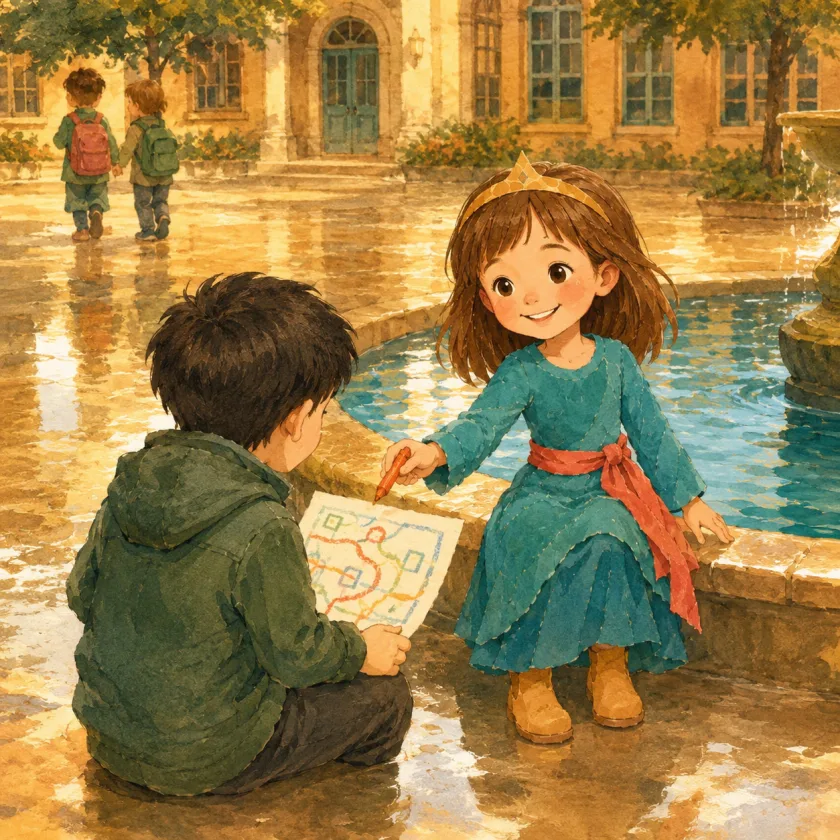
Prince Alder followed her map to the next lesson in the map room. At midday it took him to the fountain, where the others were already sitting. And there he stopped, at the edge of them, her map held flat to his chest.
The map worked perfectly. That was the worst part. It could take him to the fountain. It could not make anybody move over for him.
"It is a good map," Allison said, a little crossly, and stayed right where she was. Beside her, Princess Maren was watching too. "It is," she said. "But when I was new, you did not give me a map. You sat down."
The first drops hit the map room windows. Then the rain came down hard, and the whole school crowded in out of it, hoods dripping onto the stone, the room going warm and close and smelling of wet wool.
"Professor Fig, I gave Prince Alder my whole map," said Allison, "and he is still lost. Maybe a map is not the thing."
The maps teacher pushed his spectacles up into his grey hair and left them there, delighted. "Then walk with him, Princess Allison. Lend him your looking, not your lines."
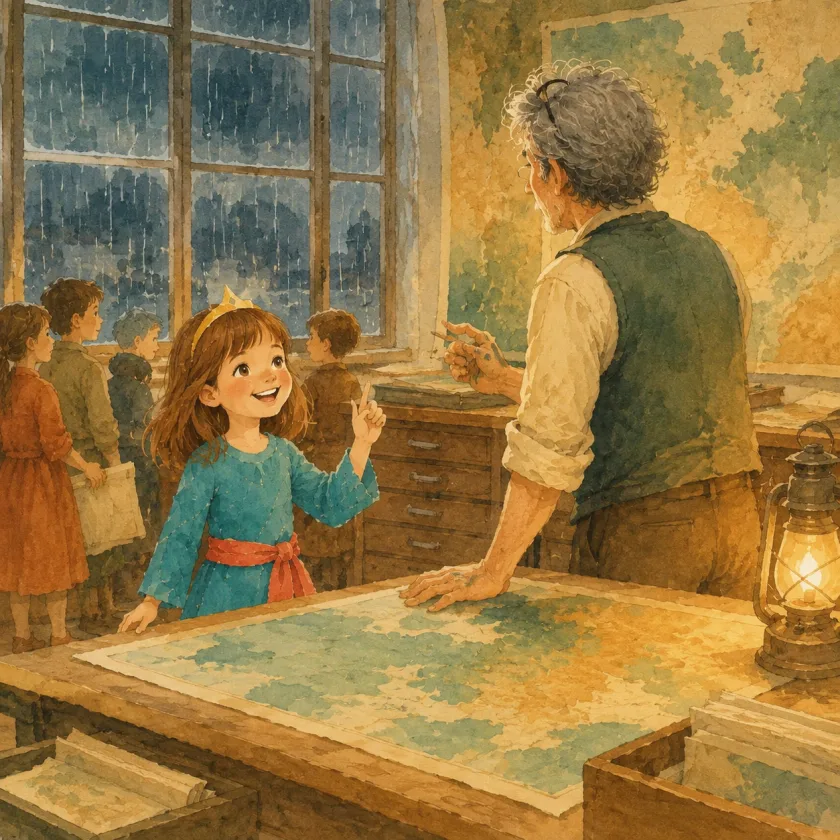
She asked Prince Alder for her map back and spread it between them. "Will you help me check the hallway lines?" she asked. "I drew some of them from memory."
He set his rolled paper on the desk and came with her. At the bend by the music room he squinted along the wall like a boy reading a ridge. "Your line is straight here. The hall is not. It bends, like a switchback. May I?"
She handed him her orange crayon, and he drew the line again with a mountain walker's bend in it. Allison rolled the checked map into her satchel, and Alder's shoulders came down the whole rest of the inch.
Alder unrolled his own paper at last: a map of his mountain kingdom, ridges like folded cloth, a tiny flag on the peak he had climbed with his mother. And then, for the first time, he talked and talked. Here was where the goats slept. Here was where the wind turned round. Here was a path so steep that even the goats said please. Allison listened to every word and did not tell him one thing about the school.
He took the blank sheet from his desk and began a map of the school. Allison did not draw one single line on it. She walked beside him with her hands in her pockets. When he took a wrong turn, they stopped together and looked back, and he found the bend himself.
By the last bell his map had a bent line and a fountain with nobody on it yet.
"Not done," he said.
"The best maps never are," said Allison.
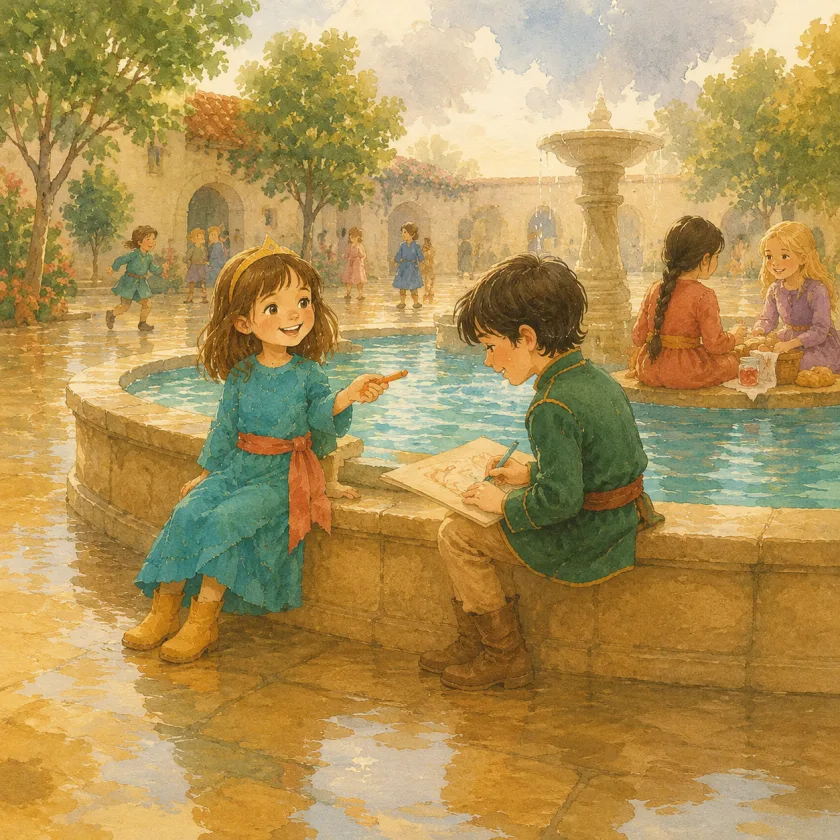
Outside, every stone had gone gold and the fountain held a second sky.
Juniper came across the yard calling, "How many goats is more goats than people?" Maren was right behind her. Allison moved over on the fountain lip and patted the place beside her. "Here, Alder." He sat. "Two hundred and six goats," he told Juniper, "and eleven people, counting me." Juniper laughed so hard she had to hold on to Maren. Soon all four were sitting on the fountain lip. The stone was warm, but the wet went straight through their clothes, and nobody got up. Alder set his new map on his knees and drew the fountain, with four small figures on it.
Allison unrolled her own map beside his. Alder pointed to the fountain, where there was room beside the three small figures. "May I?" he said, and this time she handed him the crayon before he finished asking, and there he drew himself, in his own hand.
At the door Queen Marigold said every name on the way out, "Prince Alder" among them, and he stood straighter to walk under it.
Beyond the gate a tall queen in a mountain cloak changed her whole face when Alder ran to her. And exactly where the morning had left him, the King. Two cups.
"Well," he said. "Report."
"I gave somebody my map," said Allison, "and it did not work. So I put it away and walked with him instead."
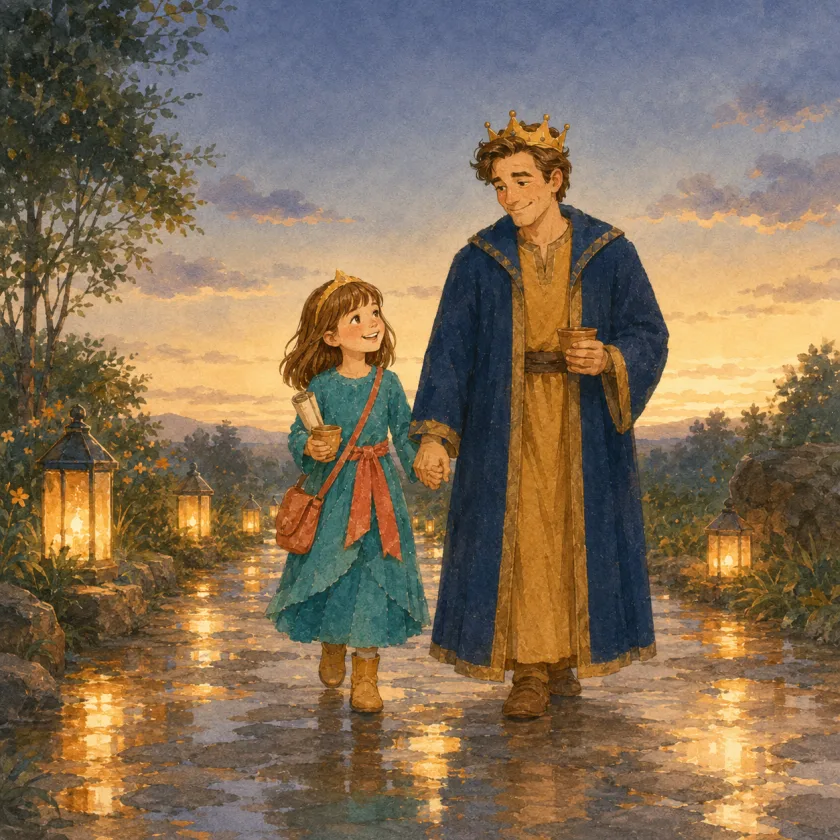
They walked home down the lantern road, every puddle holding a small gold light of its own, while Allison told the whole day at full speed.
The King listened until she stopped for breath, then gave the slow nod and put the second cup into her hands, still warm. "You walked it with him," he said.
That night her map was back on her wall, four small figures on the fountain where three had been, the newest in a hand that was not hers.
Beside it she pinned a corner Alder had drawn for her before they parted: one goat path, climbing, going somewhere she had never been.
Between the fountain and the goat path, the paper was still bare, on purpose. Plenty of room.