The Garden That Brought Friends Home
For the grown-up reading along
The magic stays gently ambiguous, and the friendships are real. Grown-ups supervise the materials and every invitation through the gate; avoid sharp edges, glass, toxic plants, and pieces small children could swallow. The open spot makes room for another person's idea while respecting every family's boundaries.
The Garden That Brought Friends Home, in full
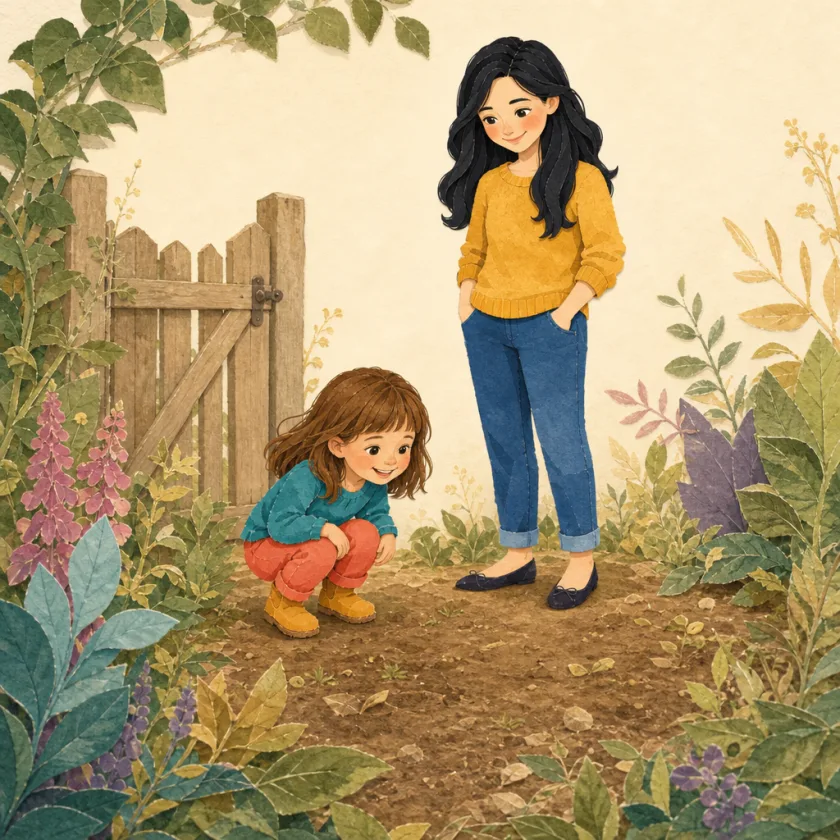
Beside the garden gate sat a bare patch of dirt where nothing much happened.
Everything else in the garden had a job. Even the worms were employed. But this corner sat empty as an unset table.
Allison crouched at it, chin on her knees. "Could we make a tiny home there?" she asked Mom. "For fairies and gnomes, in case any are looking."
Mom came and stood beside her, hands in her pockets, and looked at the same dirt for a long time.
"In case any are looking," Mom agreed, "a corner like this could use a door."
Allison rinsed pebbles under the hose until they shone. Mom lifted moss off the shady brick, and a fern came with it.
From the craft drawer came a tiny wooden door with a tinier knob. Allison carried it out on two flat hands, like a waiter with an important dessert.
"Where do doors go?" she asked.
"Where somebody might knock," said Mom. They chose the spot against the fence, under the ivy.
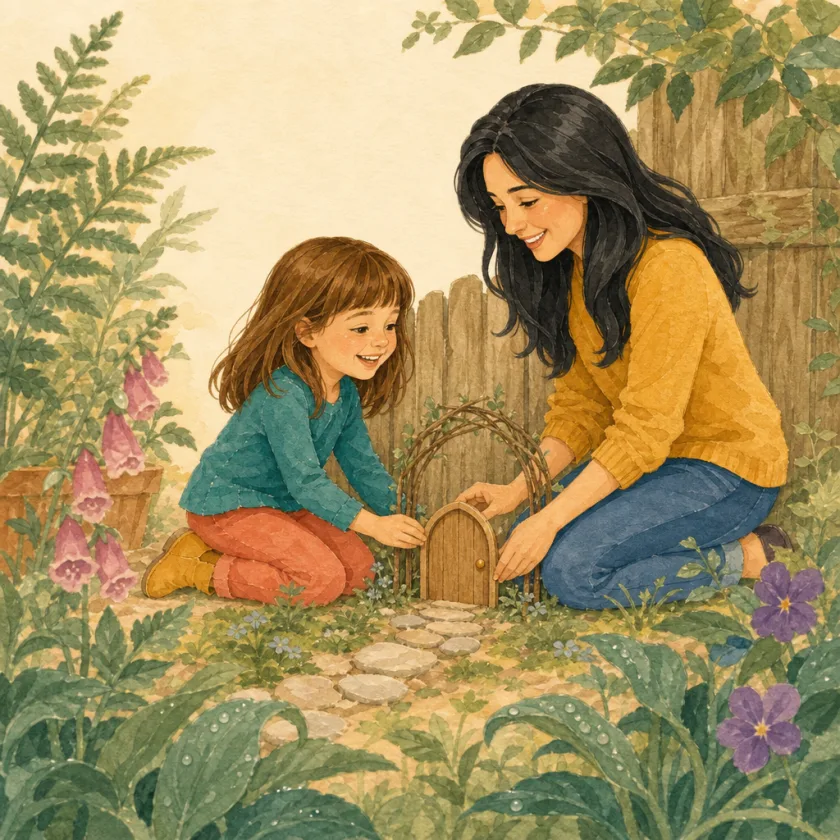
Mom held the door against the fence to see if it sat level. "Hold it there," she said, and Allison held.
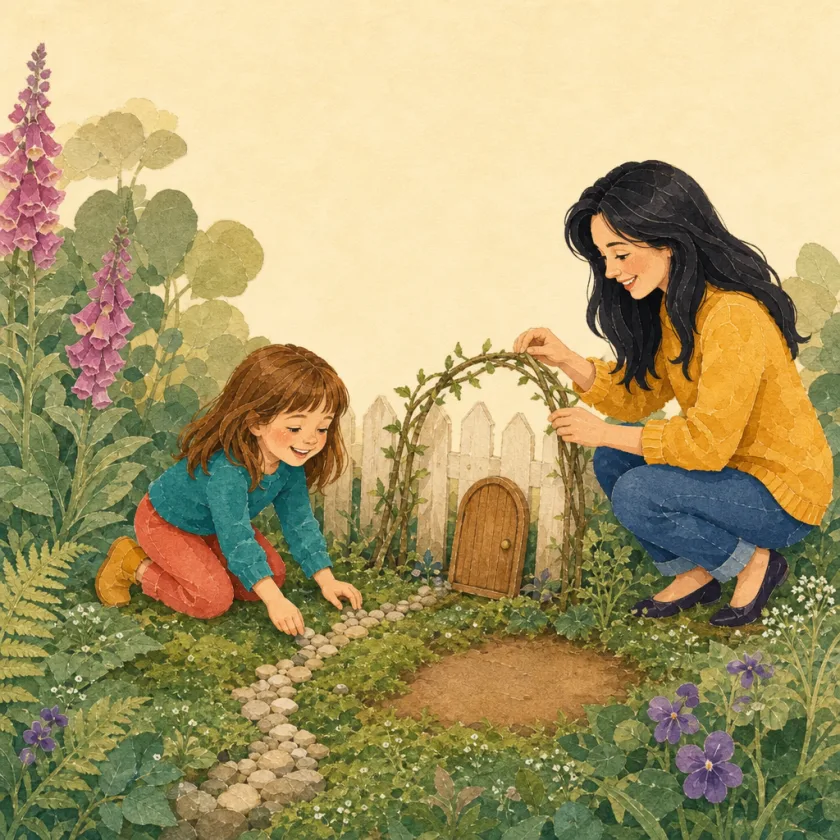
Allison laid the pebble path, stone by stone by stone, pressing each one into the earth with one careful thumb.
Mom bent a green twig into an arch. They tucked the moss in like a blanket, leaned the little door against the fence, and turned its knob once for luck.
And then, on purpose, they left one spot open. Bare dirt, at the front.
"For somebody else's idea," said Allison.
Mom smoothed the bare dirt flat with her palm. "Good," she said.
Allison waited. A bike ticked past without slowing. A dog put its nose through the fence, breathed at the ivy, and got hauled off.
A child stopped mid-step, a grown-up beside them. "Is that a door?"
Mom looked up from the herbs. The child's grown-up nodded, and Mom opened the gate. "It is a door," said Allison. "You can choose a pebble for the path."
The choosing took a long time. The child picked up a speckled pebble, put it down, picked it up again, then pressed it in with two thumbs until it sat flush.
"There," said the child, sitting back on their heels and wiping both hands down their shirt. The first gift the garden collected.
Word of a tiny door travels at exactly the speed of neighbors.
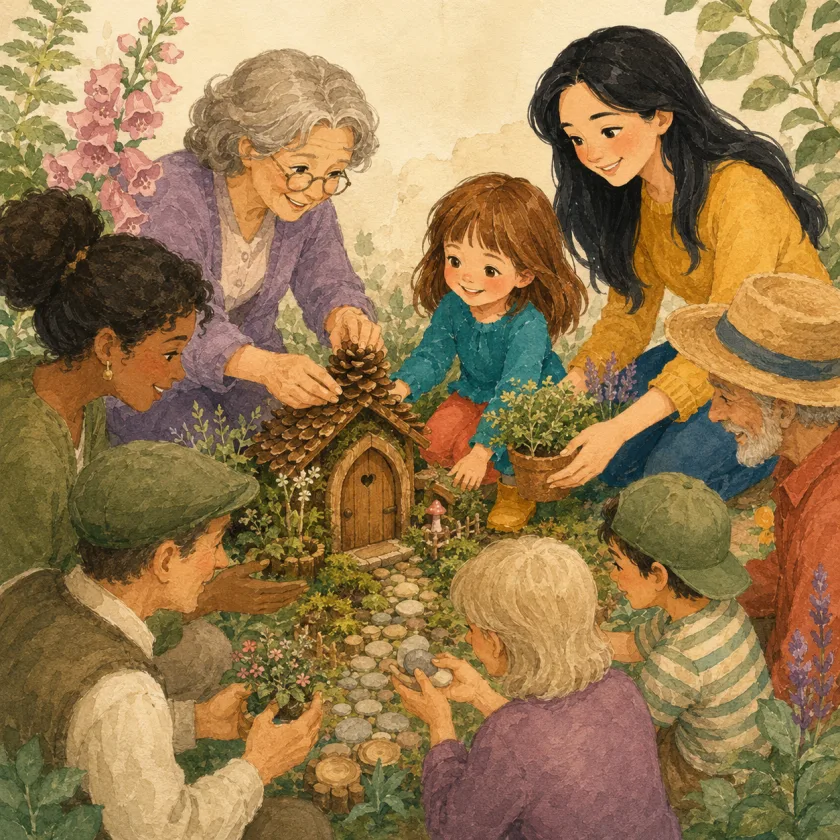
One neighbor came with flour on her hands and a pinecone that found its true calling as a roof. Another brought a pot of herbs, for the fairy kitchen, obviously. Pebbles arrived by the pocketful.
Somebody dragged a chair over and stayed. "That was the last time I planted mint," a neighbor was saying when the light went orange, her groceries forgotten on the path.
"Same time next week?" people started saying, without quite noticing they were saying it.
Rain came through one night with no manners at all. It tipped the arch and threw the pebble path halfway to the tomatoes.
Daddy was out at first light with his coffee. Before he moved a single pebble, the gate creaked. The friends had come back, grown-ups and all. Nobody had called them. They steadied the twigs and gathered the pebbles before his coffee cooled.
Allison came down in her pajamas with her chin already wobbling. Then she saw who was in the garden. She knelt among them and pressed each pebble back, one careful thumb at a time. When she ran out she held out her hand without looking, and somebody filled it.
Visits turned into whole afternoons. "A fairy who collects buttons," one child decided. Another swore the gnome snored. Nobody argued about the mouse mayor, elected fairly. One morning an acorn cap sat on the little doorstep, turned up like a bowl, and nobody would say who left it. "Somebody's settling in," said Allison, and nobody argued about that either.
The grown-ups talked nearby and learned one another's names, and then their dogs' names.
Daddy told anyone who slowed down, "My girl built that door."
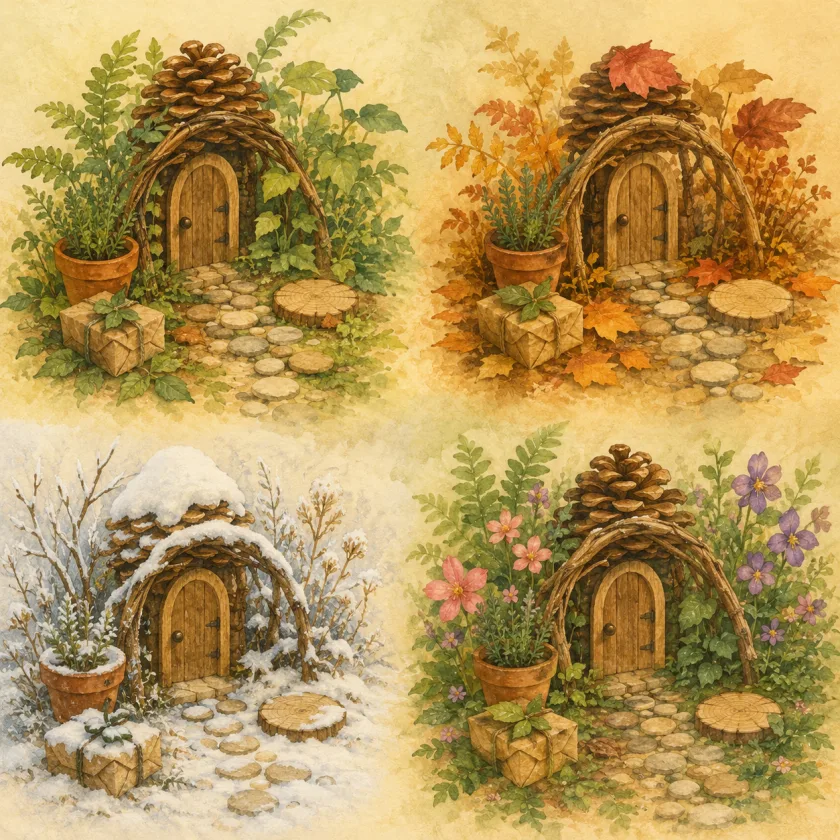
Summer warmed the herbs until the corner smelled like a kitchen the size of a shoe. Autumn dropped one red leaf on the roof, as if it had been aimed. Then snow, a white cap on the arch, boots stamping at the gate anyway. Spring rang the corner green again.
The same faces came back, season after season. One neighbor filled the open spot with a round slice of log, a table for fairy suppers. Allison looked at it for a long time, the way Mom had once looked at the bare dirt. Then she smoothed a new patch flat with her palm, a little more room at the front, for the next idea.
At the next frost, Mom came out with her mug. "Where I grew up, in Miami, nobody owned boots," she said, and set her boot-print beside Allison's.
The children grew, the way children insist on doing. Their boots got bigger. Before long they could see over the gate. Some moved far away, to streets with no tiny doors at all, which seemed to Allison like an oversight somebody ought to fix.
But nobody forgot the corner. Letters came with the garden tucked inside: a pressed leaf from a faraway park, a smooth pebble in tissue with a note that said, "For the path."
Allison tucked the leaves among the moss and pressed each new pebble into the path.
The path held stones from streets she had never walked. She knew who sent each one.
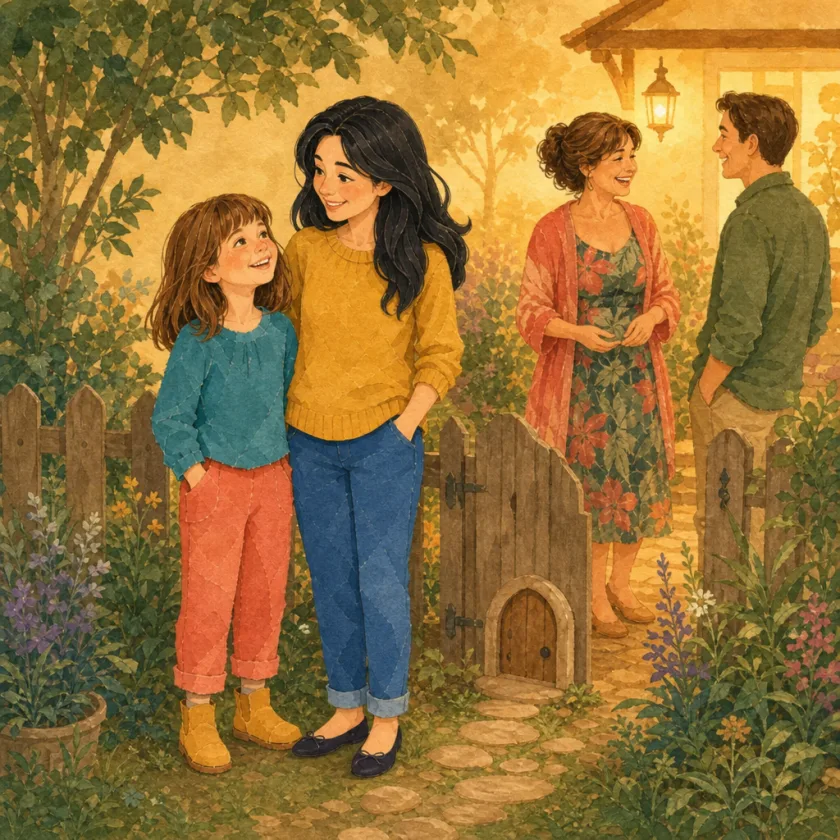
Years later, on an ordinary evening, Allison stood with Mom at the gate that came to her waist now. Under the porch lights, the one who chose the speckled pebble laughed with somebody new.
By the fence, the tiny door still sat at the end of its worn-smooth path, its knob polished by small hands turning it for luck.
Allison looked around at every face the little door had brought through the gate. She knew every one of them, the way she knew every stone in the path.
Behind them, the gate creaked open again. One more friend was coming home. The tiny door stayed closed, keeping its secret.