Papa's Quietest Beat
For the grown-up reading along
Mistakes here are recoverable, and quiet is never a punishment; Papa answers a rushed beat by resting his own hands, not by scolding. Quiet and listening are musical tools he chooses. His full-volume shows happen on his own drum sets, on his own schedule. For a child trying this at home, use a stable seat and a comfortable practice volume, then stop while it is still fun. The drum and patterns are generic and claim no specific musical tradition.
Papa's Quietest Beat, in full
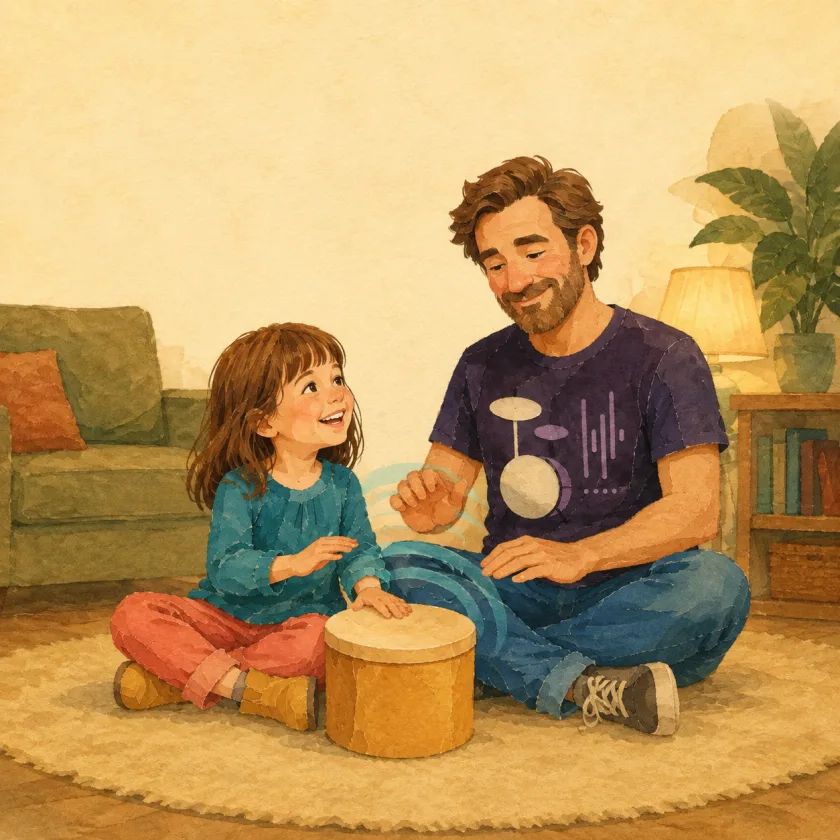
The lamp made a circle of light on the rug, and in the middle of the circle Papa set down a small hand drum.
His big drum set was waiting for its own night. Tonight he had picked the little drum and the rug and Allison.
Allison knelt right up close to the drum. "Teach me the fastest, loudest beat you know," she said. Her hands hovered over the drum, still and shaking at once, the way a hummingbird holds itself in the air. She bounced a little on her knees.
Papa took his time. One hand settled flat on his knee, and the other came up over the drum.
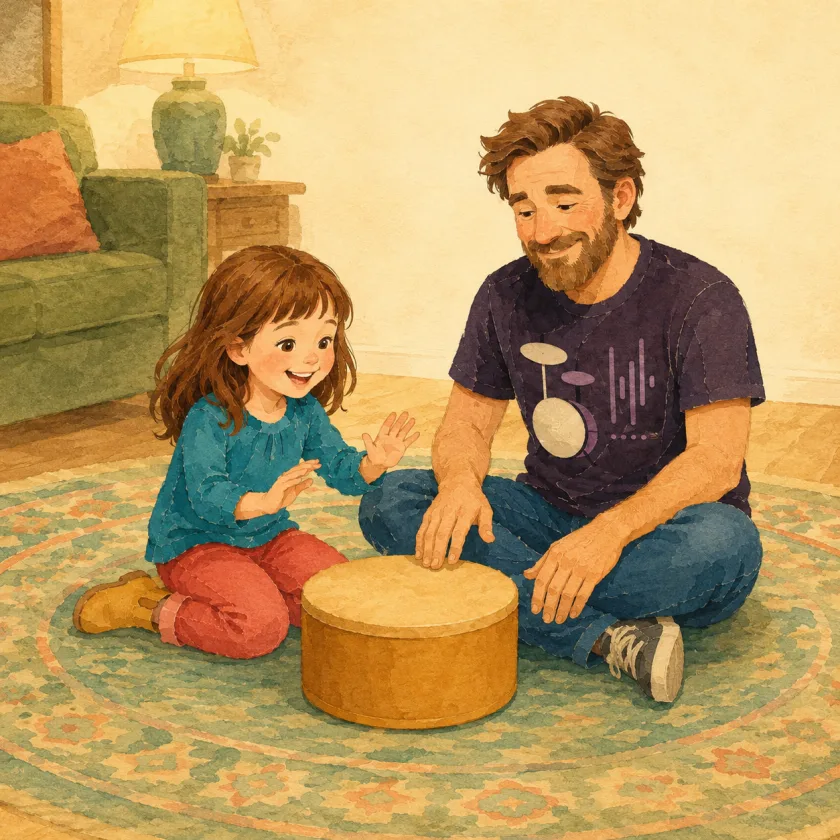
He played two soft notes instead.
Tum. Tum.
Then he waited. He let the waiting sit there between them, both hands still.
"That was only two," said Allison.
"And between them?" asked Papa. "What did you hear there?"
Allison opened her mouth and found no answer in it. Between the notes was nothing.
She leaned closer over the drumhead, in case the nothing had something in it.
"Listen again," said Papa, and lifted his hand.
Tum. Then the space. Then tum.
This time Allison listened to the space. The first tum faded all the way out before the second one came. Between them sat a pocket of quiet, small and round and held like water in cupped hands.
"Oh," said Allison. "The quiet is holding them apart."
"The quiet is holding them together," said Papa.
Papa tapped a short pattern. Tap-tap, tum.
Allison tapped one back. Tum-tum, tap.
The patterns crossed the drum and crossed back. Each time, Allison made hers a little longer, to see if Papa could keep up. He always could.
"We are having a conversation," Allison whispered, keeping her voice under the beat so it would not have to stop.
Papa nodded, and answered her in drum.
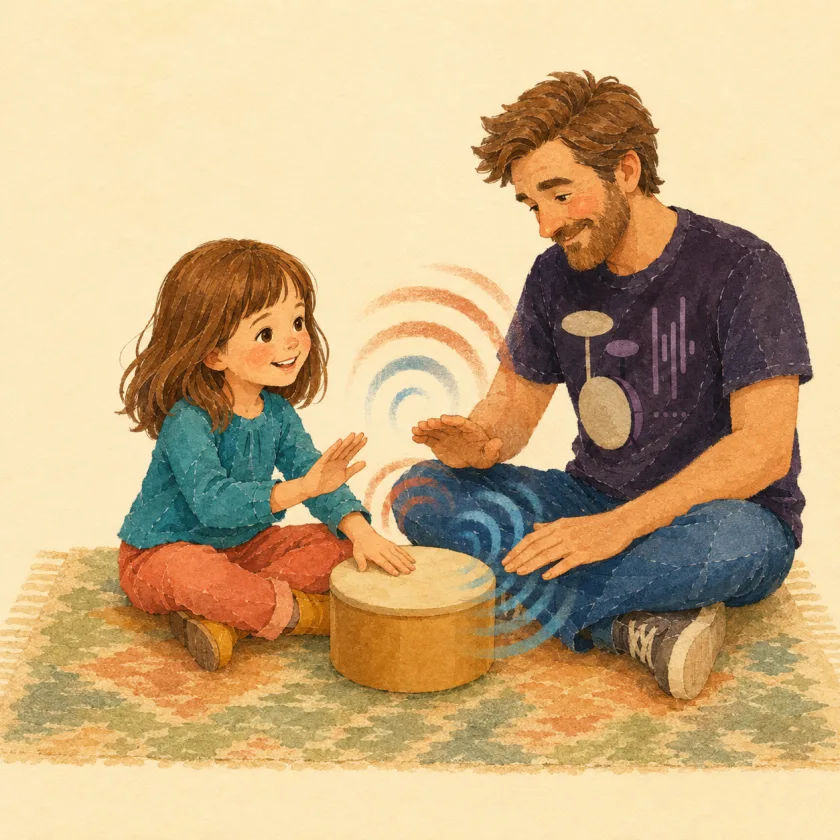
Then Allison got excited, and excited got fast. She leaned in until her chin was nearly over the drum. Tap-tap became taptap, then taptaptaptap, and taptaptaptap got away from her.
Under her clatter, Papa's steady beat grew smaller and smaller, until she could not find it.
She played louder. She played faster. The beat she was chasing slid farther away.
She stopped. The room rang with leftover noise.
Papa had not stopped. His one calm note was still there, his hand rising and falling a finger's height, no more.
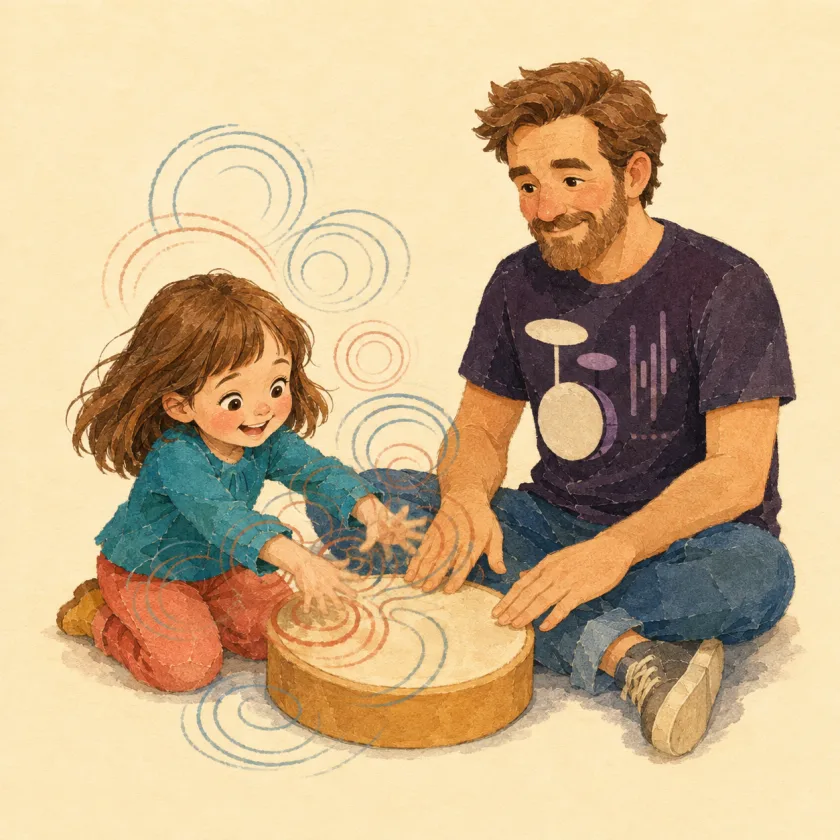
Her cheeks went warm. She folded her runaway hands into her lap and waited to be told about rushing.
Papa did not say a thing. He rested his hands too, flat on his knees, and let the room go quiet. Once, his thumb moved and then stopped.
Her cheeks cooled, and her shoulders came down from around her ears.
In the quiet, the room came in.
Rain ticked at the window. In the hall, the clock walked in place, tock, tock, tock. And under her own ribs her breath went in and out, in and out.
Then, underneath it all, Papa laid down one soft, steady pulse.
Tum. Tum. Tum.
It slid in under the rain and the clock and her breath and held them all up from below, the way a floor holds up a dance.
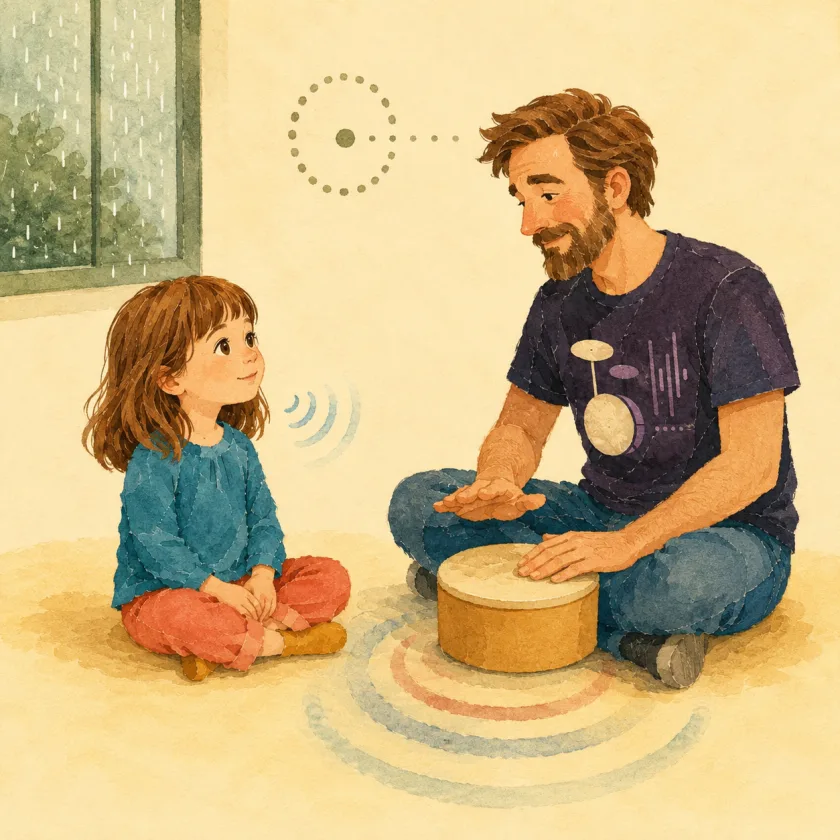
Allison waited. That was new.
She listened, and kept listening. That was newer.
When the beat came around again, she joined it. One small tap, laid down right beside Papa's, no louder than the rain.
This time she left a small space before she answered. A pocket of quiet, on purpose. Her own.
Tum. Then the space. Then tap.
Papa's eyes smiled first. The rest of his face followed.
"There," he said. "Now the quiet is yours too."
Their duet swung and bounced. Tap-tap, tum. Tap-tap, tum. Then her hands started to run again, taptaptap. This time she did not play louder. She listened down through her own noise, found Papa's pulse, and dropped her tap right on top of it. Tum. The duet came home.
"Good drummers get lost too," said Papa. "They listen their way home." He shrugged, and his hand found the pulse again.
"But you are quiet," Allison said.
"Right now." Papa grinned. He hit the little drum once, hard, and let the boom fade into silence. "I still play the loud shows on my big drums. Loud enough to rattle the plates."
Allison gave the drum one hard hit of her own. Boom. She listened to her boom fade all the way out, and then she grinned back. "Was Daddy loud too?"
Papa leaned in. "He started early. When your daddy was a baby, he found a hammer somebody had left on the floor, crawled to my bongos, and broke both. His first drum solo."
Allison gasped. "Were you mad?"
"Startled. Mad for a minute. Then the hammers went up high, and I bought a sturdier drum." Papa patted the drum. "This one has survived every drummer in this family. It will survive you too."
"Nonna says you and Daddy are the same person," Allison said.
Papa held up his hands. "Same hands," he said. "Your daddy taps those same two notes on a table edge without knowing he does it. When he cheers for you, that is my cheer too. It only got bigger on the way."
Allison played her answer. Tum.
Papa set the little drum on the shelf and clicked off the lamp. Allison went down the hall past the clock, tock, tock, tock. The house was quiet, but not empty quiet.
She lay still and listened, and the house played on: rain at the window, fainter now, and the hall clock walking and walking.
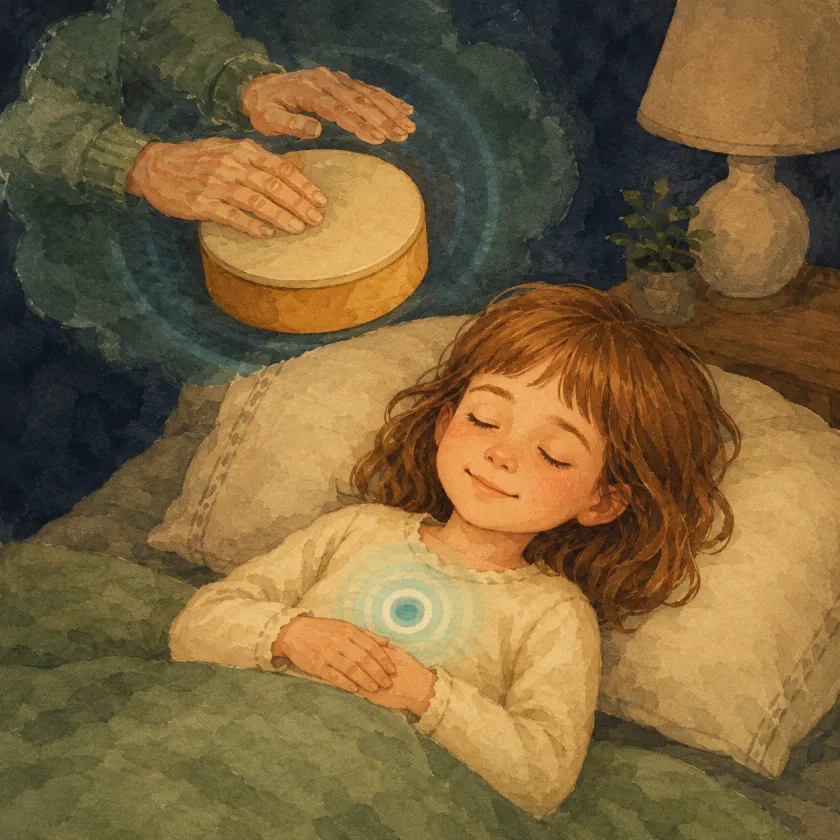
And under it all she found the steady beat inside her own chest.
Tum. Tum. Tum.
She laid her hand flat over it. Not the fastest drum she knew. Not the loudest. The quietest drum in the house.
She listened to the little pocket of quiet after each beat, just to feel it hold. She followed it, tum, tum, tum, all the way to sleep.