
The King Who Went Out Early
From the mind of Allison Colapietro · About 7 min aloud · A StoryBeam Original
For the grown-up reading alongThis book takes the question children actually ask, the one that lands hardest on a parent who is working long days, and lets a six-year-old say it plainly: do you like the gate better than me. The King neither denies it nor explains it away, because a child cannot be argued out of what she sees from a window, and the whole answer is a day in the cart. Allison's counting page is honored as real work the moment she hands it over, and the reframe from counting the going to counting the coming back is offered once and then trusted, with the drawing left entirely to her. The first stop deliberately gives her nothing, and the King offers no apology for it, so the book can say the unglamorous thing out loud: much of providing is invisible on the day it happens. Nothing here is framed as sacrifice or as a debt the child owes, no one is made to feel guilty for wanting an afternoon, and the promised sail is not traded away, only understood. Safety sits inside ordinary competence: the rules are said once before the cart moves, the child rides where the King can see her, the loading stays entirely in adult hands, and no scene depends on her being frightened. The closing gate is the point. She cannot shorten his day and the book never pretends she can, but she can change what the leaving means, and she is the one who does it.
The whole book is below, free to read together, with no account and no ads. It also lives in the Reading Nook, which remembers where you stopped.
The King Who Went Out Early, in full
For eleven mornings Princess Allison had woken before the sun, and for eleven mornings she had still been too late.
The stone sat on her windowsill, warm, with a hollow worn the size of a thumb. It meant the King had stood right there, close enough to breathe on the glass, and then gone.
Down in the yard the gate was already shut, and past it the road ran off into the gray, too far to shout at.
Allison fit her thumb in the hollow. It did not help as much as it usually did.
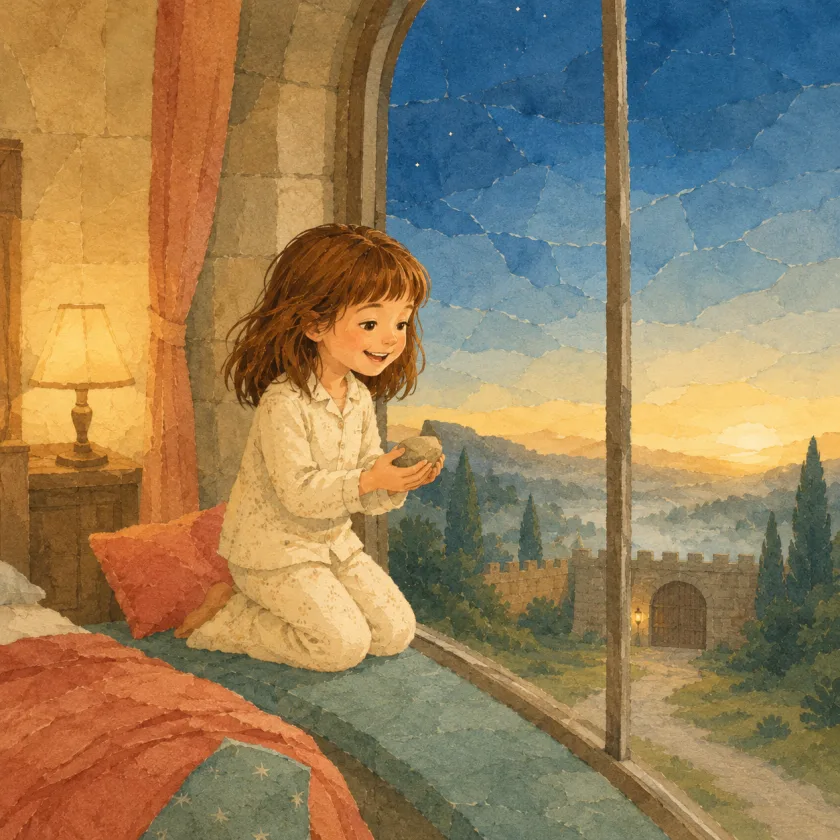
He came home after the stars again.
Allison waited up for it, with her little boat under one arm and the whole afternoon planned in her head.
"Tomorrow," she said, "will you sail with me?"
"Tomorrow," said the King, "after the gate."
It had been after the gate for eleven days.
Allison looked at her boat with its mended coral sail. Then at her father's boots, which were the muddiest things in the palace.
"Daddy," she said, "do you like the gate better than me?"
He set his cup down. He did not say of course I do not, and he did not laugh. It was a real question, and he had heard every word of it.
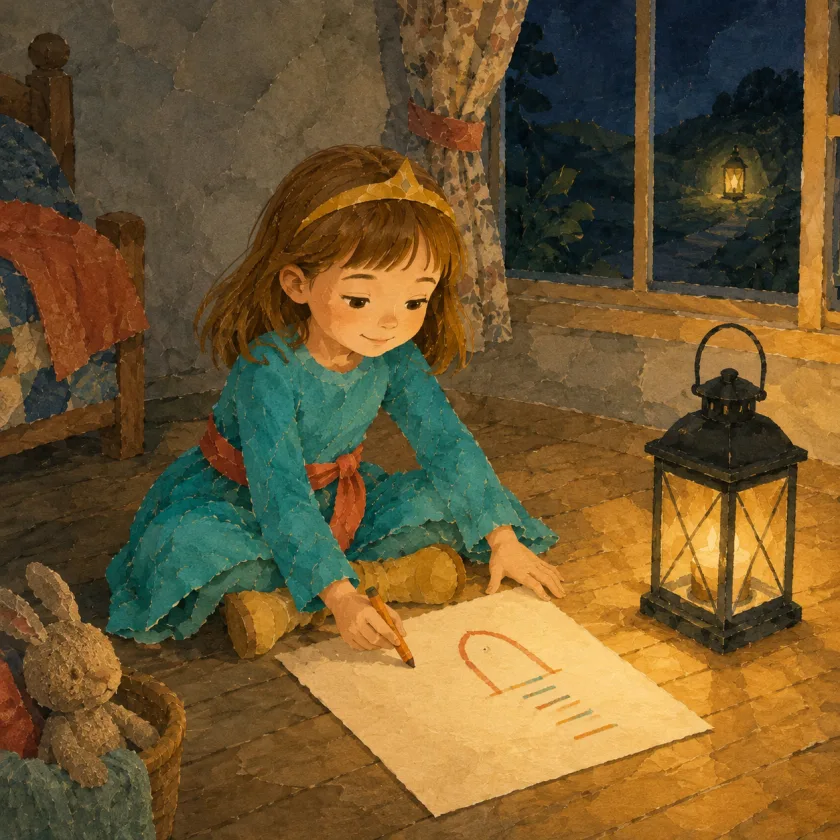
That night Allison sat on her floor with her backup orange crayon and made the saddest plan she had ever drawn.
First the gate. Then one mark for every day it had taken him, in a straight row, left to right.
Eleven marks.
There was room on that paper for a great many more, and that was the part she did not like looking at.
She did not cry about it. She rolled it up instead, because a plan you can hold is a plan you can hand to somebody.
In the morning she finally beat the sun.
She was on the stairs with the roll of paper before the stone ever reached the sill, and she put it into the King's hands while his coat was still half on.
He read it standing in the doorway, slowly, and then twice, out to the last mark, which is exactly how he reads the kingdom's own papers.
Then he crouched to her height, where he keeps the important things.
"You counted the going," said the King. "Nobody has ever counted the going. Now come and count the coming back."
The rules were said once before the cart moved: stay where the King can see you, and the horses belong to the driver, so the driver says when.
The first stop was a roof.
A woman with a leaking roof stood in her yard with the King, and the two of them looked up at it and counted slates out loud, then counted them again to be sure. Nothing was carried. Nothing was mended. Nothing came back.
Allison's page stayed as empty as a clean plate.
"There is nothing to count," she said. She had meant it as a complaint. It came out smaller than that.
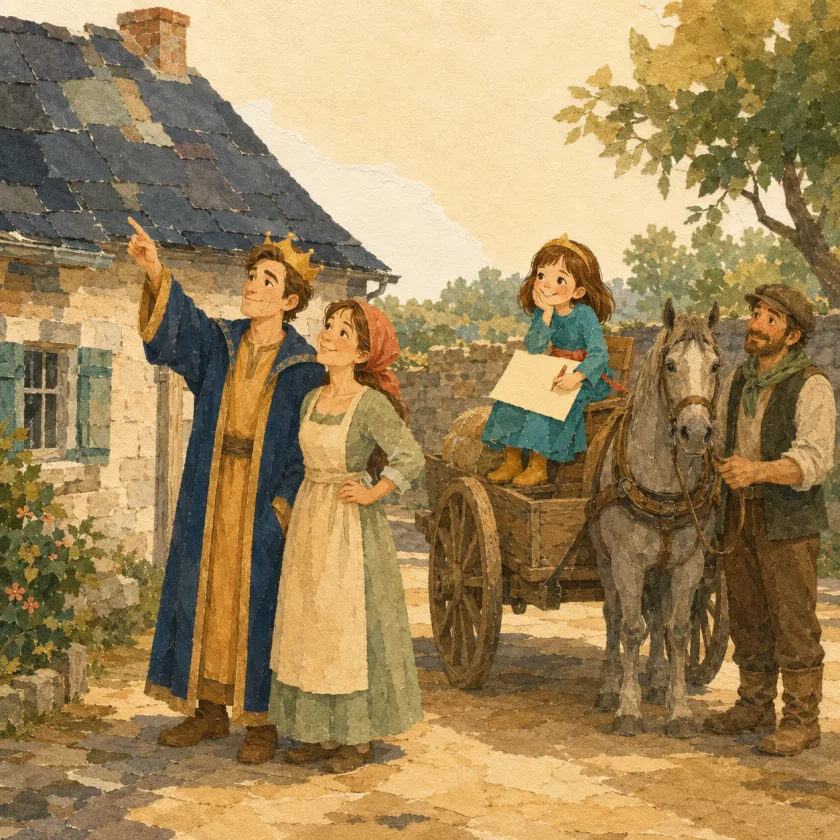
"Slates get counted in the spring," said the King, "and carried in the fall. Today was the counting."
He said it with no apology in it, and Allison noticed.
The second stop was a mill.
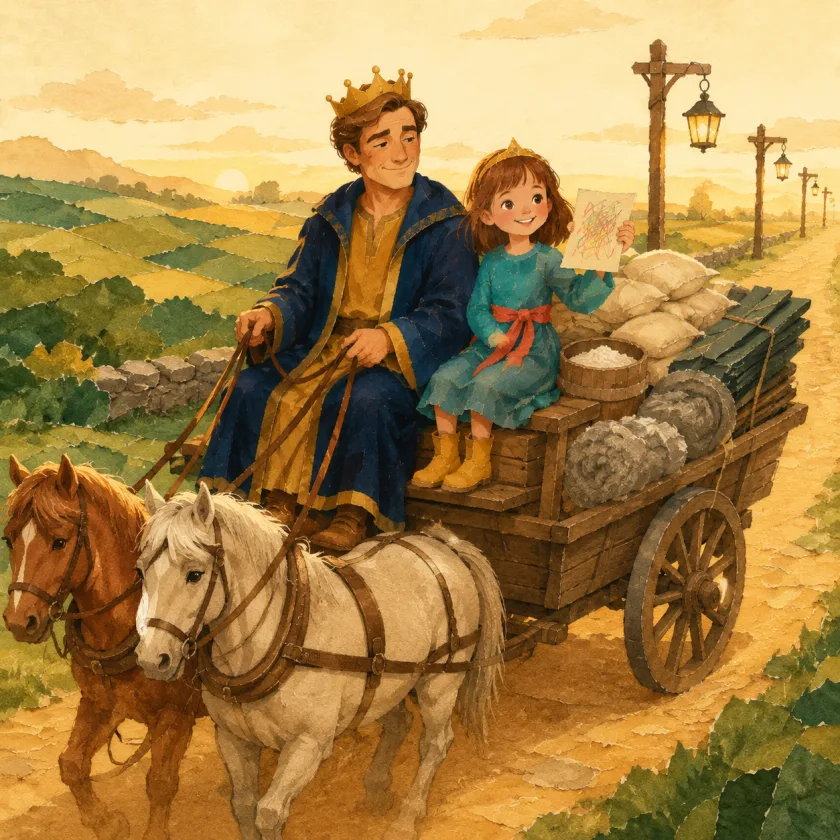
Flour came out of the mill in sacks, and the King put them up on his own shoulder, one after another, and swung them onto the cart.
Allison leaned in and put her nose close to one.
She knew that smell. It was Tuesday morning. It was the bread on her own table, before it was bread, before it was anything at all.
Then she opened her page and made one mark.
After that she could not draw fast enough.
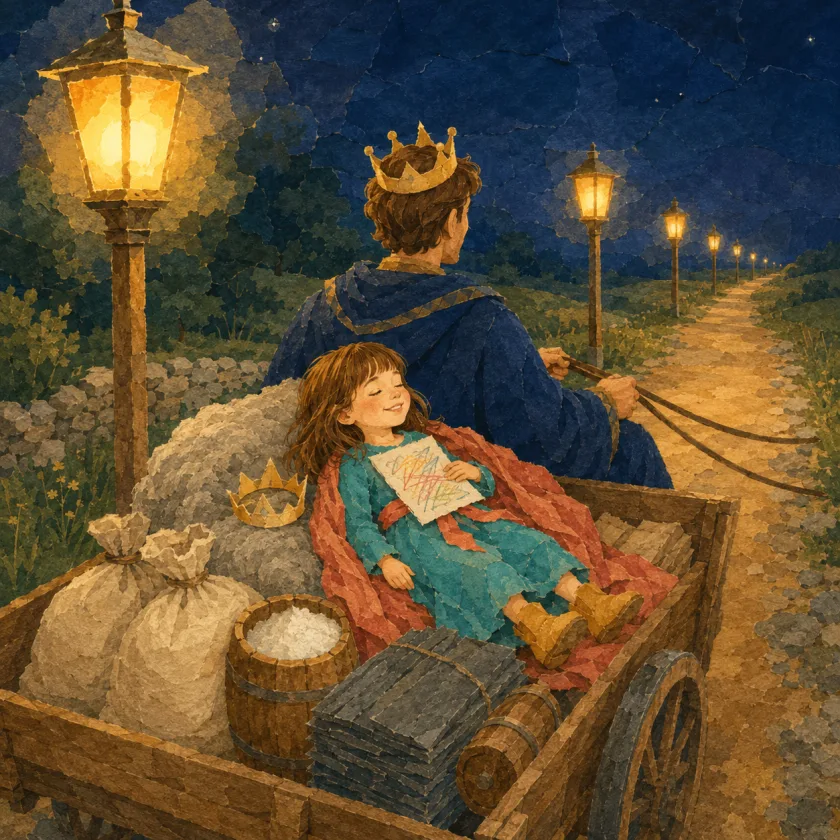
Salt came aboard in a barrel. Wool in a bale, gray and oily and warm. Then nails, lamp oil, and a bundle of long slates for somebody else's spring.
The King carried every one of them himself. He ate standing up, out of one hand, and did not sit down once.
He asked after every family by their own names, and he had all of them. They asked after Allison by hers, which is how she found out he had been telling them about her all along.
Then she started making marks for things that do not fit in a cart.
They came home in the dark with the lanterns coming up gold along the road, one and then the next and then the next.
Allison lay back against the wool bale with her page held over her face. She could not see it anymore. She knew what was on it.
"I thought you were leaving," she said.
"I know," said the King. "I go out empty and I come home full. From your window that only ever looks like going."
Allison thought about that the rest of the way, and it was a long way.
At home she laid both papers side by side on the floor under the lantern.
The first had eleven marks on it and a great deal of empty room left over.
The second had marks all the way down and around the edge, and she had turned it over and kept going, and run out again.
Allison sat back on her heels and looked at them both.
"They are the same eleven days," she said. "I was only counting the wrong end of them."
The next morning Princess Allison beat the sun again, and did not stop at the window.
Past the stone on the sill, down the stairs, out across the cold yard in her boots.
She got to the gate first. When the King came out with his cup she was already there, both hands on the heavy latch. She lifted it and pushed, and the road did not look the way it used to.
"Now it is not you leaving," said Allison. "It is me sending you out, and I will be here to let you back in."
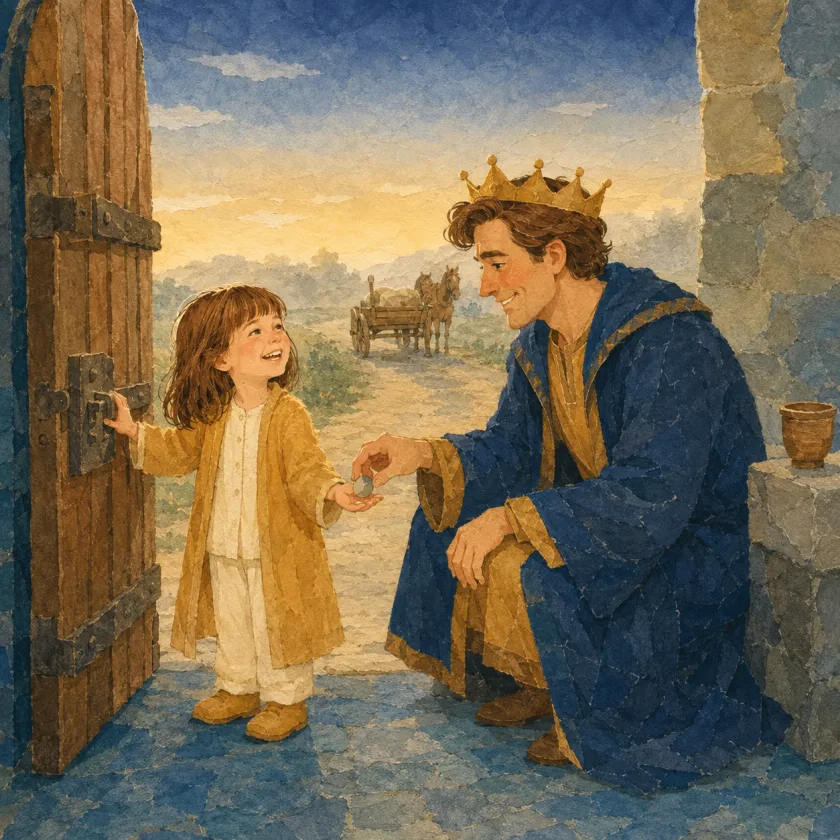
The King did not say one word. He crouched to her height, pressed the warm stone into her palm, and went out to work.
She held it until the road was empty, then went in to breakfast, because there was a whole day to get through before the coming back.
Story Steps
Story Steps
For after the story. Pick your size.
Words from the story
- latch the small bar that holds a gate or a door shut.
- mill a building where grain is crushed into flour.
- slates flat pieces of stone laid in rows to cover a roof.
- bale a large bundle of something like wool, tied up tight.
- barrel a round wooden container with flat ends.
- cart an open wagon pulled by animals, used for carrying loads.
Little · 3-5 Talk about it
-
Point to the stone Allison is holding at her window before the sun is up.
-
Show me how you would open a heavy gate with both hands.
-
Say one thing on your table that somebody had to carry home.
Big · 6-8 Talk about it
-
Why does Allison's first page have room for so many more marks than she wants?
-
What changes for Allison when she smells the flour at the mill?
-
The first stop gives her nothing to count, and the King never says sorry for it. Why not?
One thing to do
- Little Draw one thing from your kitchen, then draw the place you think it came from first.
- Big Pick one grown-up in your house and write down three things they do that you never see happen.