

The King's Day Off
For the grown-up reading along
Allison's care stays exactly child-sized: bread and jam with no flame, a place prepared for resting, and room-temperature water she can carry while the hot drink stays with a grown-up. The King accepts help graciously and out loud, modeling the half of strength grown-ups show least. At the stream he remains awake, present, and reachable; the boat string rests loose in Allison's open hand, and they share the noticing. Rest is honorable work here, and the kitchen keeps its own watch too, so Allison's companionship stays a gift, never a job she carries alone.
The King's Day Off, in full
Boots on the stair before the birds. Then the front door, easing shut behind him. Princess Allison knew her father's mornings by their sounds, and the order they came in.
Before breakfast he had walked the walls, listened to the weather, moved a bench for two gardeners, and cleared a whole table for a beekeeper. The kingdom leaned on him.
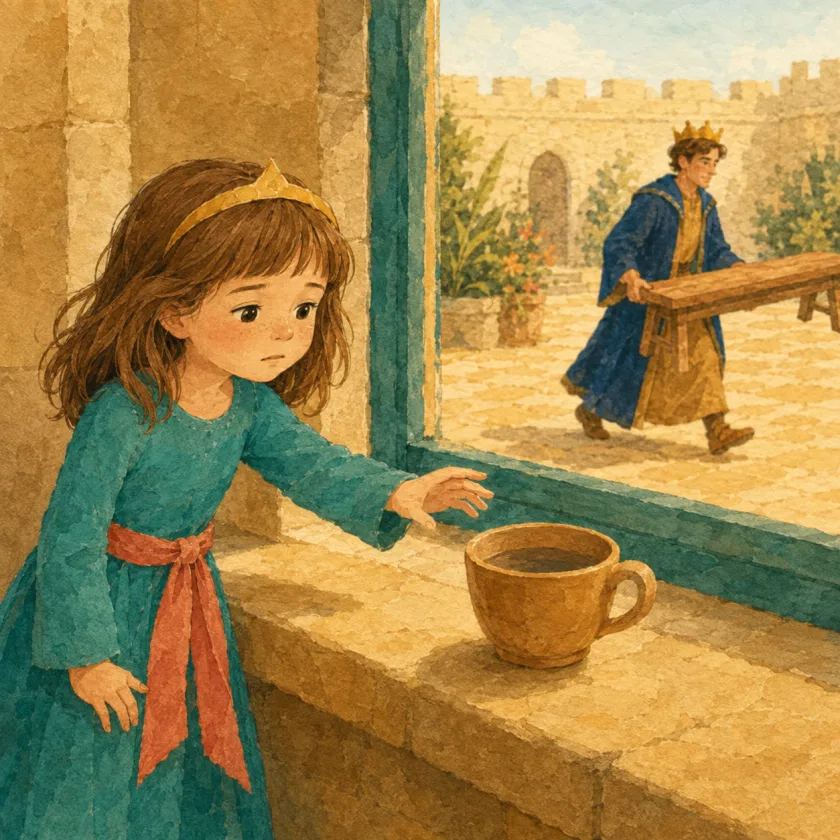
That morning, Allison found his cup on the windowsill.
Full to the top. Colder than the sill it stood on.
She put her hand around it the way you check a forehead. The King never forgot his coffee. He had set this one down somewhere between everyone else's mornings and never come back for it.
She followed him for an hour with her notebook, through the kitchen door, up the stairs to the wall, and down again past the beekeeper's table. A dot for every job he did for somebody else. A circle for every time somebody said thank you and he said it was nothing.
The page filled. Dots like rain. Not one mark for anything anybody had done for him.
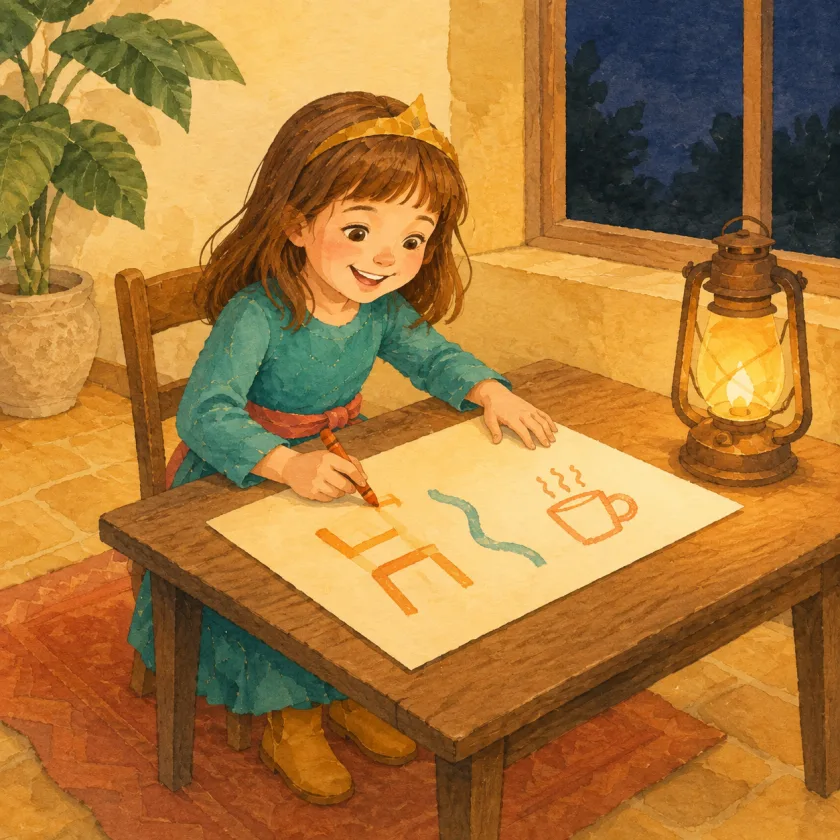
So she found a fresh sheet of paper and made a plan for the one royal job nobody ever scheduled.
With her backup orange crayon she drew the good chair by the south window, where the sun lands all afternoon. The willow came next, and the stream bank under it, because resting outdoors counts double. Then bread and jam, which she could make with her own hands, no flame, no ladder.
And in the middle, where the important thing goes, she drew a cup with steam coming off it in three proud curls. The coffee would be hot, and a grown-up would carry it.
She rolled the paper tight and went to find him, carrying it in her fist the whole way.
"Tomorrow," she announced, "you have an appointment. All day. It is me."
The King opened his mouth to explain about the fence and the beekeeper.
Allison held up the plan like a small scepter. "You cleared a whole throne room for my plan once," she said. "Before I even finished asking. I am asking for one chair."
The King closed his mouth. He unrolled the plan and read it a long time. "The fence can wait a day," he said. "And the beekeeper has a fine clear table." Then he sat down on the step to study the chair she had drawn.
"One chair," he agreed. "For somebody else's idea."
"For mine," said Allison.
Morning came. Allison was at the south window before he was down the stairs, with the blanket over her arm and the plan flat on the sill, a stone on each corner.
He spotted a crooked cushion on the next chair and started to get up. She pointed at his seat. He sat. A bird landed on the sill and the King offered to find it a crumb, and Allison said the bird had its own plans. "Sit."
A palace grown-up carried the hot coffee out on a tray, with three curls of steam coming off it, exactly as she had drawn them. Allison kept well clear until the King had drunk it. Then she brought her own part, slowly, in both hands: a plain cup of cool water, with no steam at all.
Allison settled the blanket around him and tugged it straight. Then she stood beside the good chair with her arms crossed, guarding the appointment.
"Well," said the King, from inside the blanket. "Well, well, well."

At midmorning she carried the plate over on her own and put the napkins down square, and the King left the window for the table. Bread she could reach, jam she could spread. He ate as solemnly as a king at a royal banquet, until the jam reached his thumb.
Halfway through, the King's eyes drifted toward the kitchen, where the soup pot lived, and he began to rise. "Sit," said Allison. "Soup is a stove job, and today you have no jobs."
"This," said the King, with jam on his thumb, "is better than soup."
In the afternoon they went out the side door, Allison with her little boat and the King with the blanket. She picked the long way to the stream, out past the gate and through the tall grass, so they would not pass the fence. At the bank the King helped launch the boat with its mended coral sail, then stretched out on the grass. The boat's long string lay loose across Allison's open palm, ready to slip free if the boat tugged.
The patch caught the sun and held it.
The King rested awake under the willow, eyes open and close enough to answer. Allison sat beside him with her heels in the cool grass and the string still across her hand, and they watched the stream and the sky and the road together.
A duck went by with somewhere to be.
Once, his hand crept toward the crown, the way it did whenever somebody might need him. Allison moved the crown one hand farther away. Nobody came up the road. The stream talked to itself, and the King's hand stayed in the grass.

At dusk they gathered the boat and the blanket and walked home as the lanterns came on. The King walked slower than usual.
"I dug none of these lantern holes," he said, "and it is the best-lit road I know."
"The diggers dig where the princess marks," said Allison.
"And a day like this one," said the King, "is not a thing I am allowed to skip."
At the door, before goodnight, the King crouched down to her height.
He held out his hand for the notebook. Allison dug it out of her pocket, and the orange crayon after it. The King found the page of dots and then the bare part at the bottom, the part for things somebody had done for him. He pressed one orange mark there. "One," he said, and gave it back. "And it was not nothing."
"Same appointment next month," said Allison. "It is already drawn."
"I will be there," said the King. "You bring the plan."
That night the cup on the windowsill stood empty, and rinsed.