The King Who Crossed the Storm
For the grown-up reading along
Allison is never outdoors during the storm; the recovery happens after the weather has passed, and the King owns every step that touches water. Allison's part is the map, the spotting, and the mending: real work, sized for her hands. Nobody teaches her that the storm was dangerous by being afraid of it; the grown-up simply handles the grown-up part, which is how children learn what steady looks like.
The King Who Crossed the Storm, in full
The storm came up the coast at bedtime, when the lamps were lit and the shutters had already been latched once.
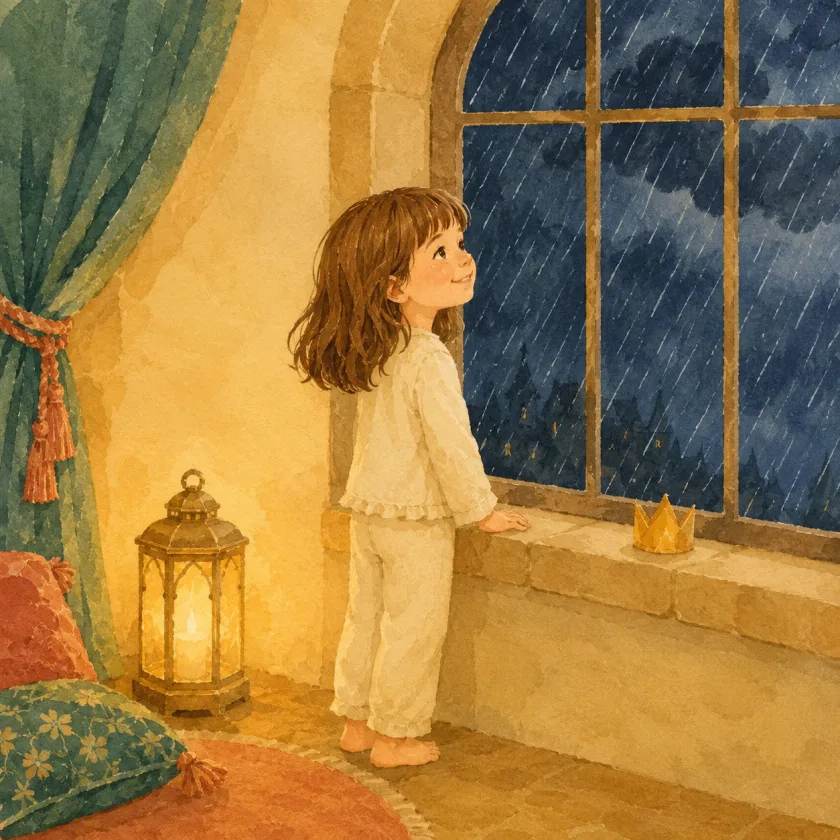
Princess Allison stood at her tall window and watched the rain come at it sideways. Her breath fogged the glass. She wiped it clear and looked past the wall, out to where the stream ran.
That afternoon she had sailed her boat at the stream landing, pulled it up on the bank to dry, and tied it to the willow root. She had built it over four evenings, down to the coral sail she cut and hemmed herself.
Then the sky changed its mind about the evening. Her boat was out there in the dark, and the stream was rising.
She found the King, her father, in the long hall. He stood with his head tipped and one hand flat on the cold window ledge, listening to the weather.
"My boat is at the landing," she said. "I tied it to the willow root. The stream will rise."
He did not say it was only a boat. It was four evenings of her hands.
"A storm is for waiting out," he said. "First light is for going. We will go and see."
"We?" said Allison.
"We," said the King.
She took the stairs two at a time.
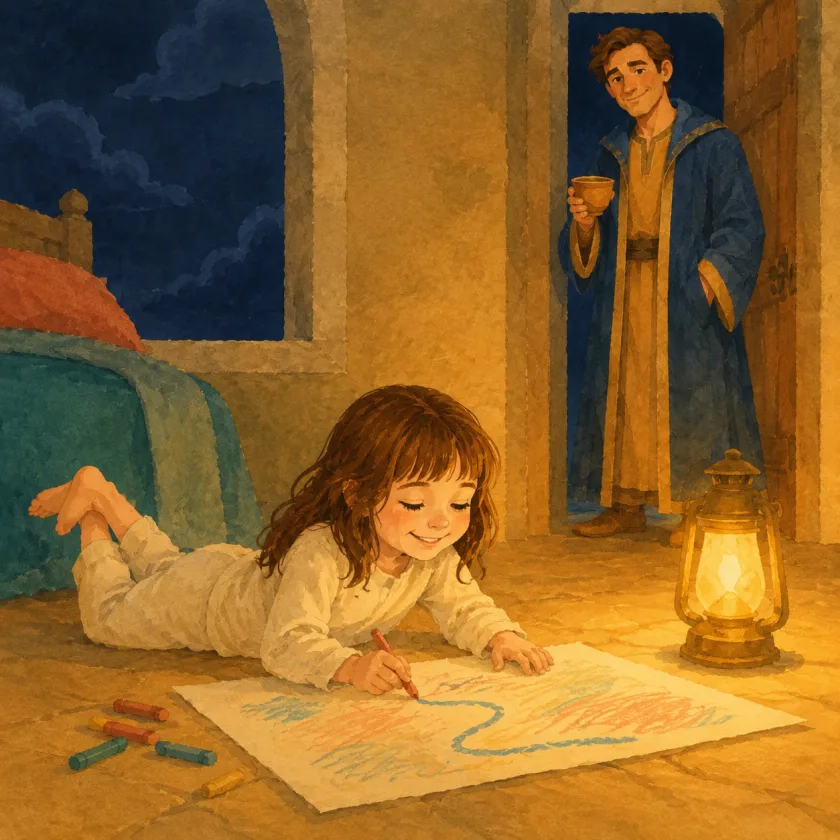
Back in her room, where the lantern was already glowing, she spread a fresh sheet of paper on the floor and drew the stream in one long blue line.
If the knot slipped, the stream would carry the boat past the reed bend, over the stone shallows, down to the old fallen log where floating things go to get caught. She numbered all three in orange crayon.
"The stream only runs one way," said Allison from the floor.
"That," said the King from her doorway, "is the thinking of a person who gets her boat back. Sleep now. First light does not wait for princesses."
The storm spent the whole night arguing with the roof and lost.
Allison slept the way you sleep when somebody has said we. Her map lay folded on her boots, where her feet would find it.
Before morning the thunder moved along the coast to bother somebody else, and the rain rinsed the sky clean.
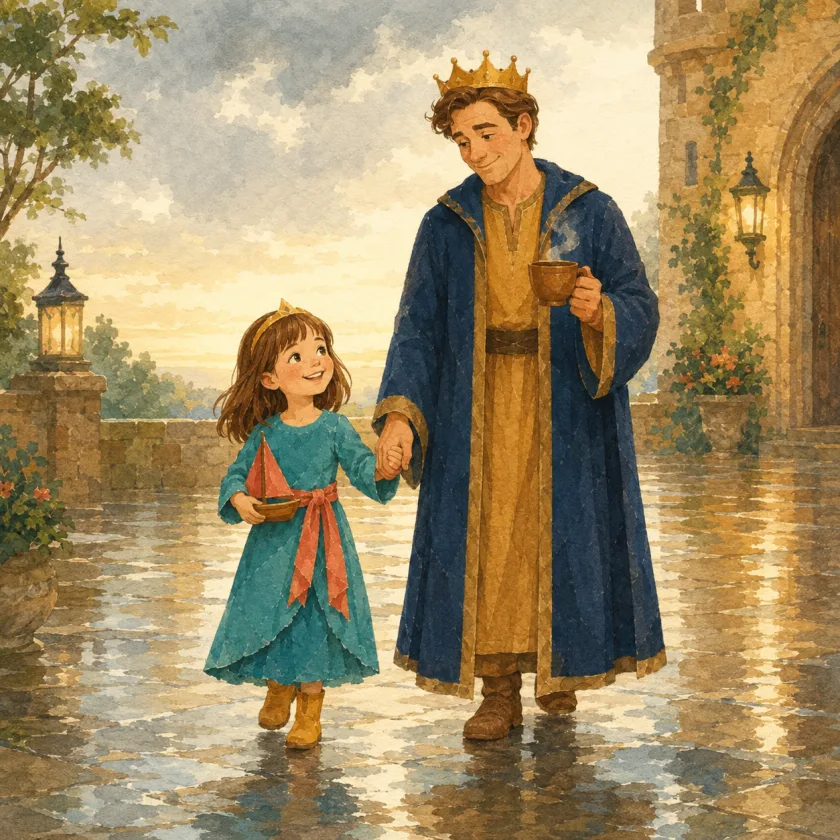
The courtyard door swung open on cold air off wet stone. First light was over the wall, and two people crossed flagstones the storm had left shining.
Allison wore her boots and her crown and carried the map. The King carried his coffee, steam hurrying away on the wind. Puddles lay across the stones like small silver countries.
"Left over from the storm," said Allison, meaning the wind.
The wind shoved him twice and pressed his sleeve flat to his arm. He drank anyway. Not one drop spilled.
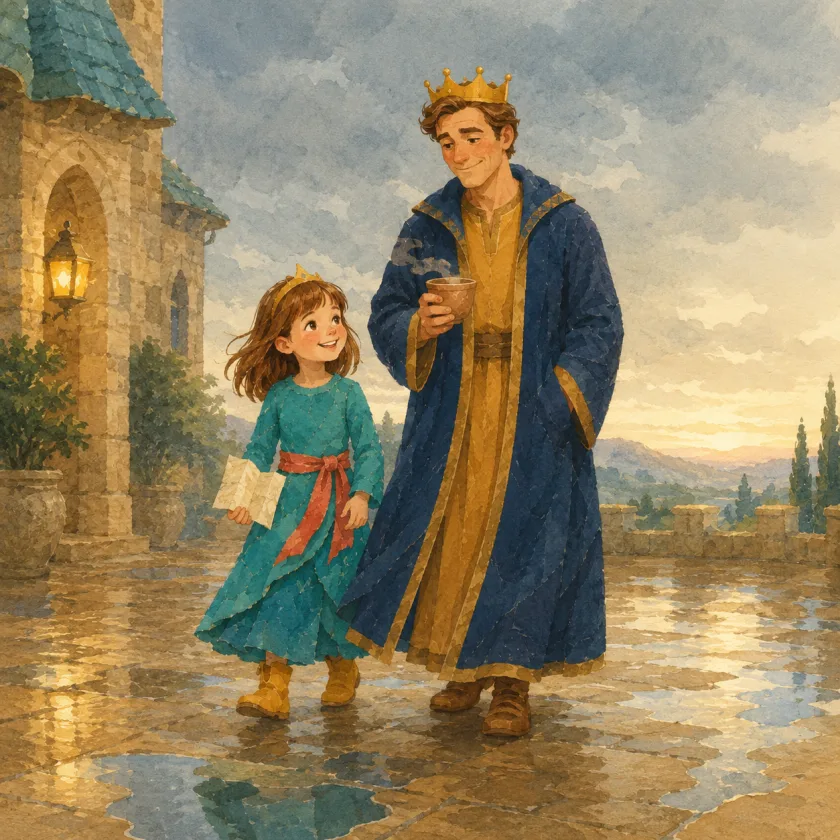
They heard the stream before they saw it, loud and brown and over its own banks. The King chose the high path, above the water. From there they could see the willow root wearing a loop of string and nothing else. The knot had held. The string had not.
"Reed bend next," said Allison, and folded the map down to the first number.
They followed the water down. The reed bend held three ducks, one barrel lid, and no boat. The ducks looked as though the storm had been their idea and had gone well.
At the shallows, the King stopped where the path was firm and held out his hand. Allison took it and looked down. Something coral lay in the water. Her heart jumped. It was only weed, curled like a hem come loose.
She stood still, her thumb pressed into the fold of the map. The water went on going. Then she turned the map to the last orange number and held it up.
"Number three," said Allison. "The old log, where floating things go to get caught."
Below the shallows the bank flattened, and the old fallen log lay across the slow water like an arm gathering everything the storm had dropped. And there, against it, coral sail soaked dark, was one small boat.
"There!" said Allison. "Past the branch. Left of the big stone."
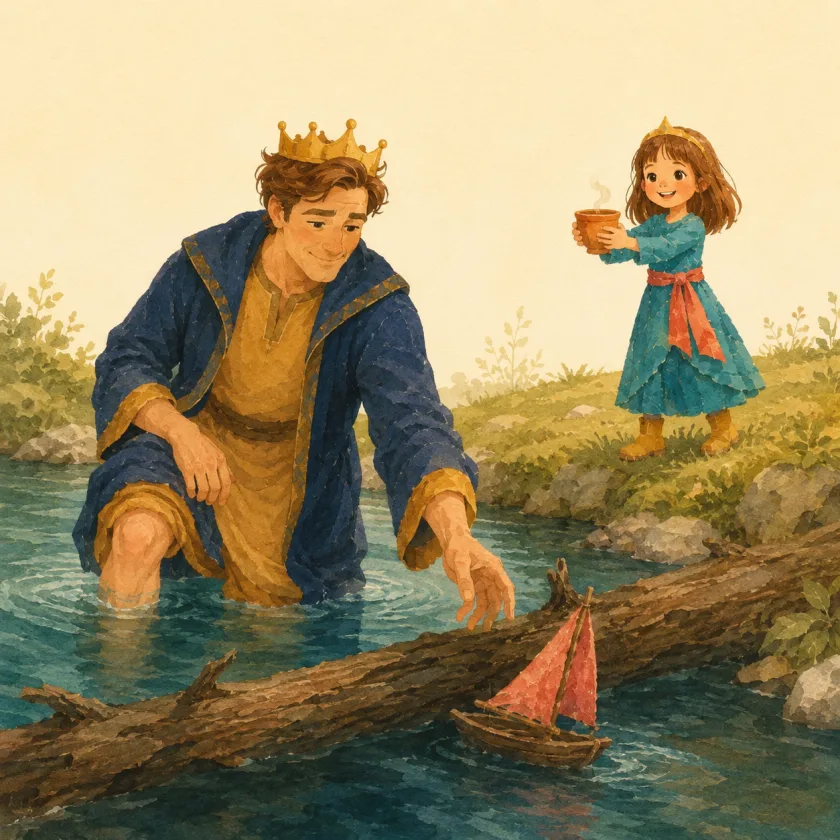
The King finished his coffee before he went near the water. He tucked the empty cup away and took a plain cup of cool water from his satchel.
"Hold this for me," he said. "Both hands, while I use mine."
He tested the edge first, then waded in with his robe hitched up, steady as a bridge. The water came to his knees and no farther. He set each foot down only where it was firm, one step at a time.
"Left," called Allison from the bank, the plain cup in both hands. "Now right. There." His fingers closed on the hull.
They sat on the bank while the boat drained. The sail had torn along one seam, and Allison turned it in her hands to see what it needed.
"I can mend this," she said. "Dry the hull, sew the seam, wax a new string."
"I believe you will," said the King. "If you need somebody to hold the string, I am free."
That evening the boat stood drying on Allison's windowsill, its mended sail patched with a coral brighter than the rest. She turned it so the patch faced the room.
The King came to say goodnight and looked at it a long moment.
"I know where the stream puts things now," he said. "And there is no storm I would not cross to bring back four evenings of your hands."
"With your coffee finished before the wet part," said Allison.
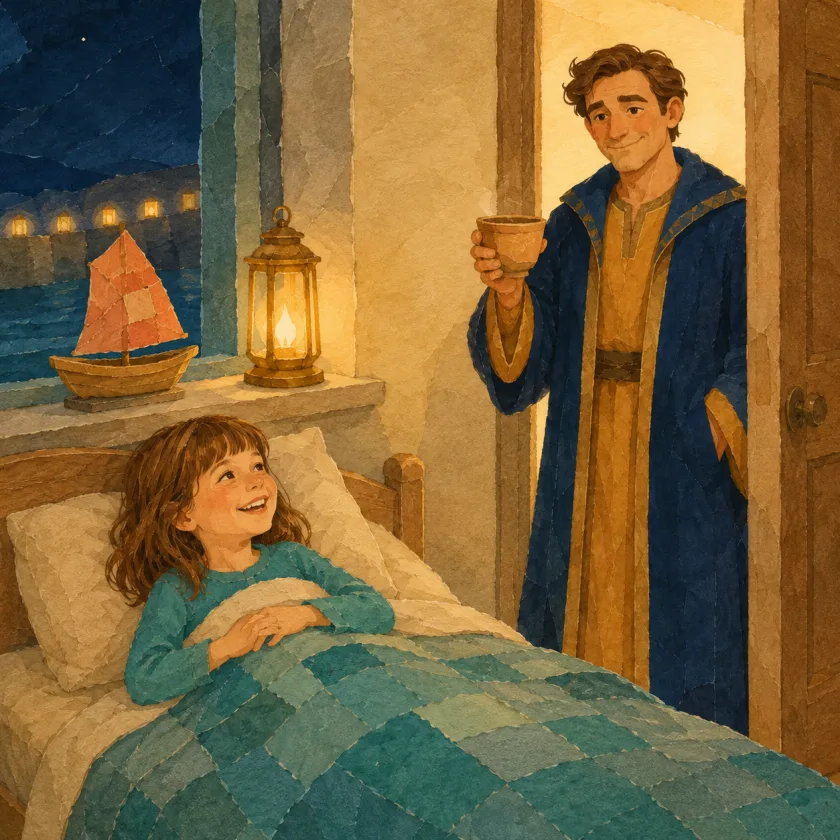
The King laughed and raised his cup to her from the door.
Outside, the lanterns came on along the walls, one gold ring after another.