
The Queen's Keys
For the grown-up reading along
The Queen's first book runs on a no that respects the child. Allison's opening plan is treated as genuinely good and genuinely incomplete, and the no arrives with its reason sitting right beside it, plus a road back: bring me a plan that knows all four seasons. Commitment is modeled as love with a schedule, never as a lecture, and when Allison returns with a keeper's plan instead of an afternoon's, the key is offered on an open hand and every bit of the work stays hers. The door's own last no, unlocked but sewn shut by old ivy, is solved by her child-height noticing, not by an adult reaching over her. Tall jobs, tools, and the high ivy stay with the King; the Queen teaches with her voice and her forethought, and the basket she packed before anyone asked is named and credited in the text. This is also the book where Allison calls the Queen "Mommy" for the first time, once, at the key, and calls the King "Daddy" at the hardest push, and nobody knocks on the finished door tonight, because a kept welcome does not need a visitor to be true. Lights-out lands on a quiet bell, a gold doorstep, and a key on its ribbon, done for today.
The Queen's Keys, in full
Princess Allison was drawing the castle garden, which was harder than drawing the whole kingdom. On her kingdom map, mountains stayed mountains. In the garden, beans climbed and ivy hid things. She drew as far as the west wall, then pushed the ivy back with the flat of her hand to see the stone underneath, and the crayon in her other hand stopped.
There was a door.
A small door, exactly her height, with a keyhole shaped like a tall flower. "You were hiding," she said. The door said nothing, in the locked way doors say it.
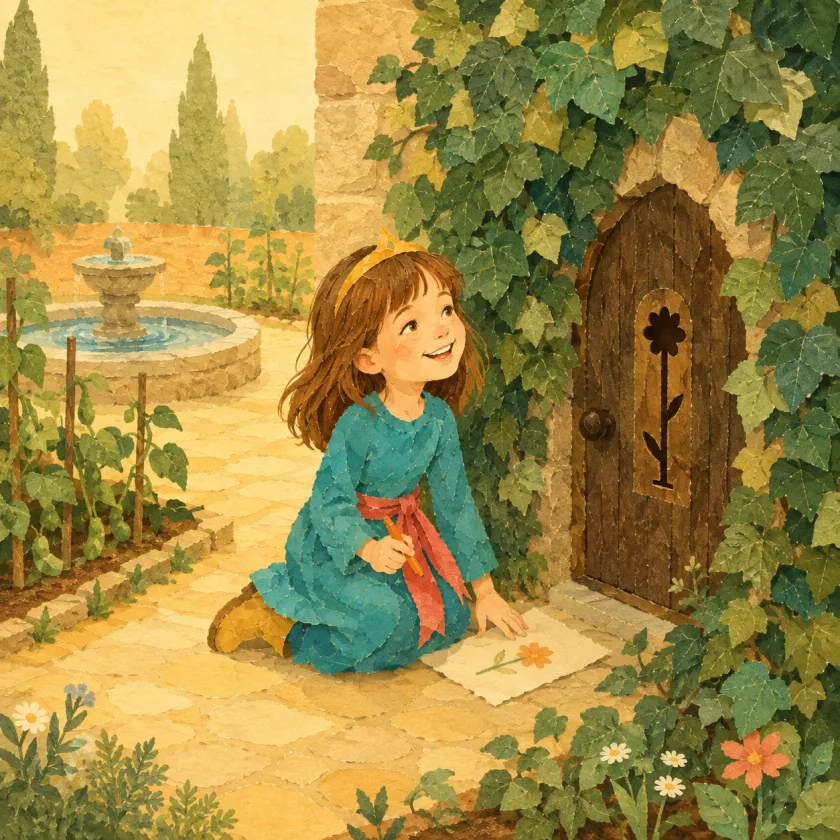
She tried the handle, politely. Locked.
"Whose little door is this?" she called up to the King on the ladder in the pear tree.
"Every door in this castle answers to one ring of keys," he said.
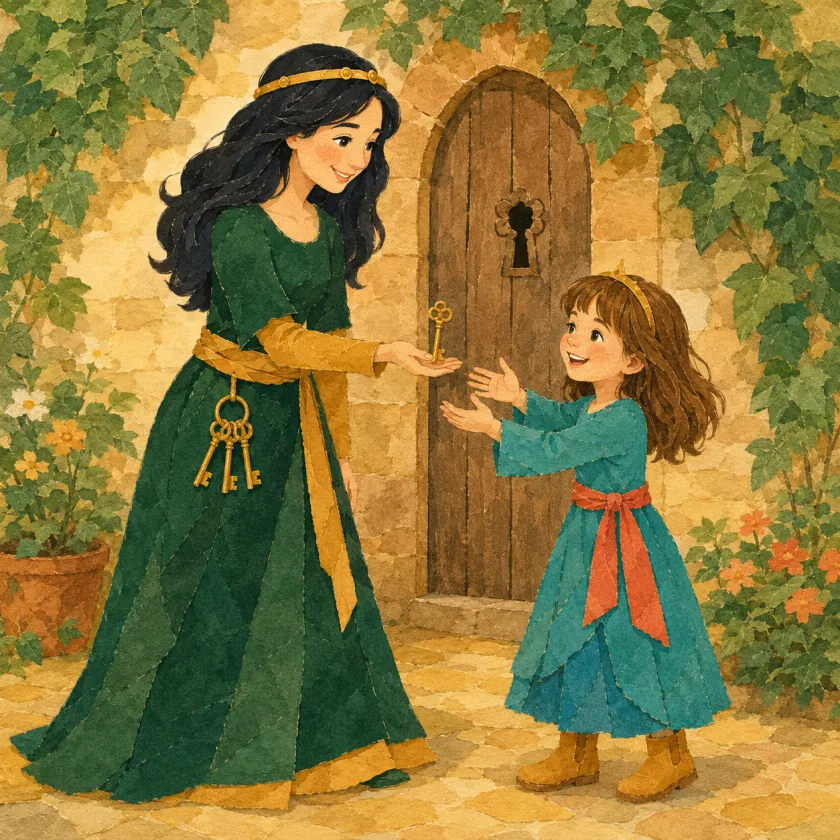
And there, coming down the garden steps with the morning basket, was the Queen, four gold keys swinging at her side, one for each season.
Allison took out a fresh sheet of paper and her backup orange crayon and wrote the title first: OPEN THE DOOR. That way, the walkers on the lane would not have to go all the way round to the big gate. Under the title went the whole afternoon: sweep the sill, and wave at every walker until suppertime.
She brought the plan to the Queen at a run, holding it up ahead of her. The Queen read it twice, then folded her hands over the ring of keys, and Allison understood, one breath early, that the answer was going to be no.
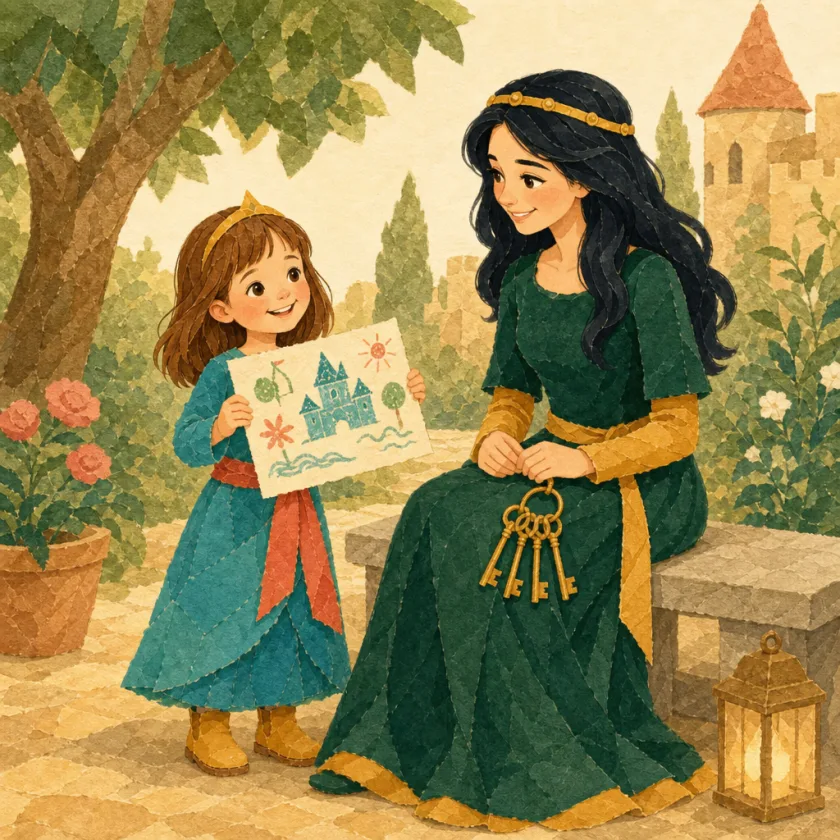
"Not with this plan, my love," said the Queen. "Open it for one afternoon and the walkers learn to knock here. What happens tomorrow, when you have gone to play? A door needs someone to answer it, in frost and in the long hot quiet of summer."
The no went into Allison like a key turned the wrong way. She opened her mouth to say she would answer it every single day. Then she thought about tomorrow, and the day after that, and frost, and closed it again. The Queen did not fill the quiet. Behind them a pear came down through the leaves and into the grass.
"Bring me a plan that knows all four seasons," the Queen said, "and we will talk about keys."
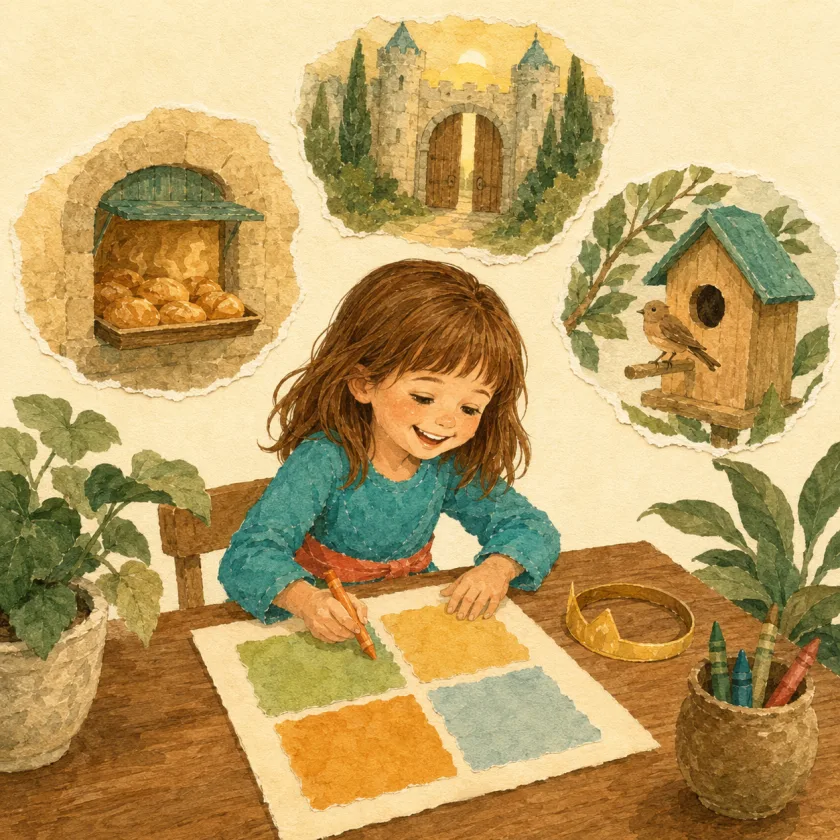
That day Allison watched doors instead of people. The big gate was unbarred at dawn and barred again at dark, and somebody did both. At the bakery, somebody opened the hatch before the first loaf was sold and swept it clean before closing. At the bird house, a bird went out, flew off, and came back with supper.
Kept doors had keepers.
At her desk she crossed out OPEN THE DOOR and wrote a truer title: KEEP THE DOOR. Under it she drew four boxes, spring, summer, autumn, winter. In each she drew the mat to shake, the hellos to answer, and the Queen, for the days Allison could not be there herself.
The new plan was the same size as the first one. It just knew more.
The Queen read the new plan three times.
"Winter too?" she asked.
"Winter too," said Allison. "Mittens are in the box."
The Queen laughed, worked the smallest key off the ring, and held it out on her open hand. Then she waited.
"Locks like to be asked, not told," she said. "Slow hand. Small turn."
Allison lifted the key. It was lighter than a spoon, and it made her hand careful. "Thank you, Mommy," she said.
They went down the garden steps and along the west wall, the gravel loud under her shoes. In the cool of the ivy-shade a basket was already waiting: an oil can, a rolled mat, and a small brass bell.
"You knew," said Allison.
"I hoped," said the Queen. "Hoping is allowed to carry a basket."
The King came along the wall, set down his cup, unwound the high ivy, and oiled the top hinge. Allison swept the sill and hung the bell on the low hook. The Queen stood beside her at the lock, hands behind her back.
"Ask it," she said.
Allison slid the key in. Slow hand. Small turn.
The lock listened. Something inside it lifted and clicked, the sound of a very old yes.
Allison pushed. The door did not move.
She pushed again, harder, one hand flat on the planks and all her hopes behind it. Nothing.
She looked up at the King. "It will not open, Daddy," she said, and heard her own voice go small on the last word.
The King checked the hinges. Oiled. The Queen checked the lock. Asked, and answered. The door was unlocked. The door still did not open.
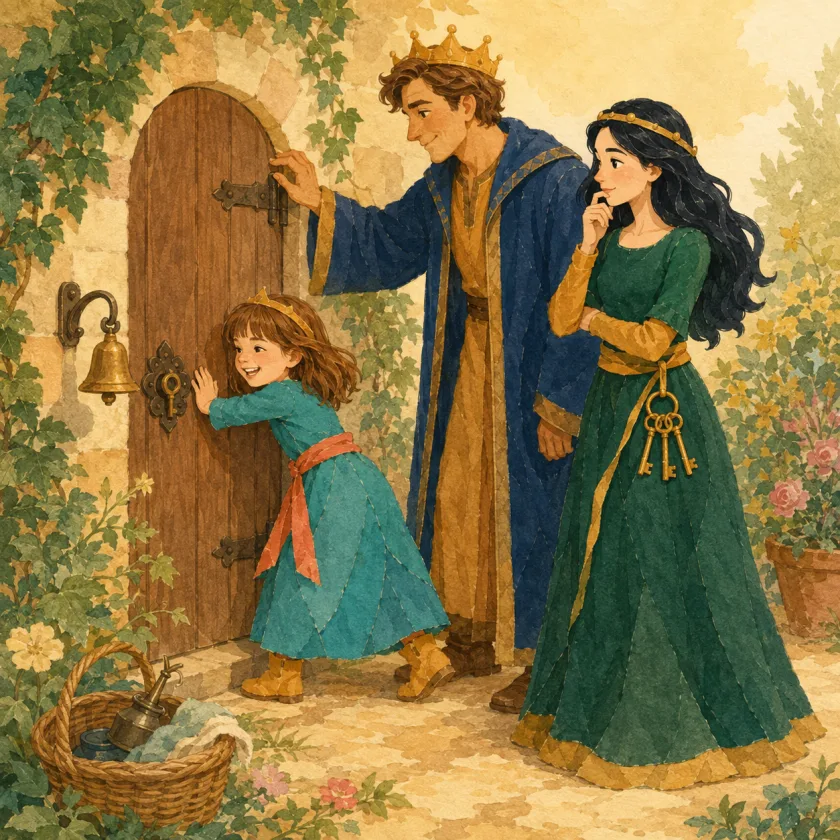
Allison sat down hard on the sill and crossed her arms. Then she leaned her cheek against the cool stone, and from down there she could see all along the bottom of the door.
And there it was, low in the seam where door met frame: ivy. Thin green stitches sewing the door to its own wall.
"It is not stuck," she said. "It is sewn."
She unpicked the low stitches, one thread at a time. The King drew out the one high runner she could not reach. Then Allison took the handle and asked.
It opened with the sound of an old yawn. The lane was there, and the hedgerow, and the sun already low behind it.
They laid the mat. Down the lane the King's lanterns came on, and the nearest one, on the wall above the door, set a gold square on the doorstep.
Nobody knocked that evening. A rabbit stopped at the edge of the lane, looked at the open door for a long moment, and decided to think about it somewhere else. Allison waved anyway. She sat on the sill until the last orange light had gone out of the lane. Then she shook the mat, just as her plan said, and set it straight again.
The Queen touched the little bell once, so lightly it only thought about ringing.
"Open is only today," Allison said. "Kept is all the days."
The King's cup had gone cold in his hand. He raised it anyway and said nothing.
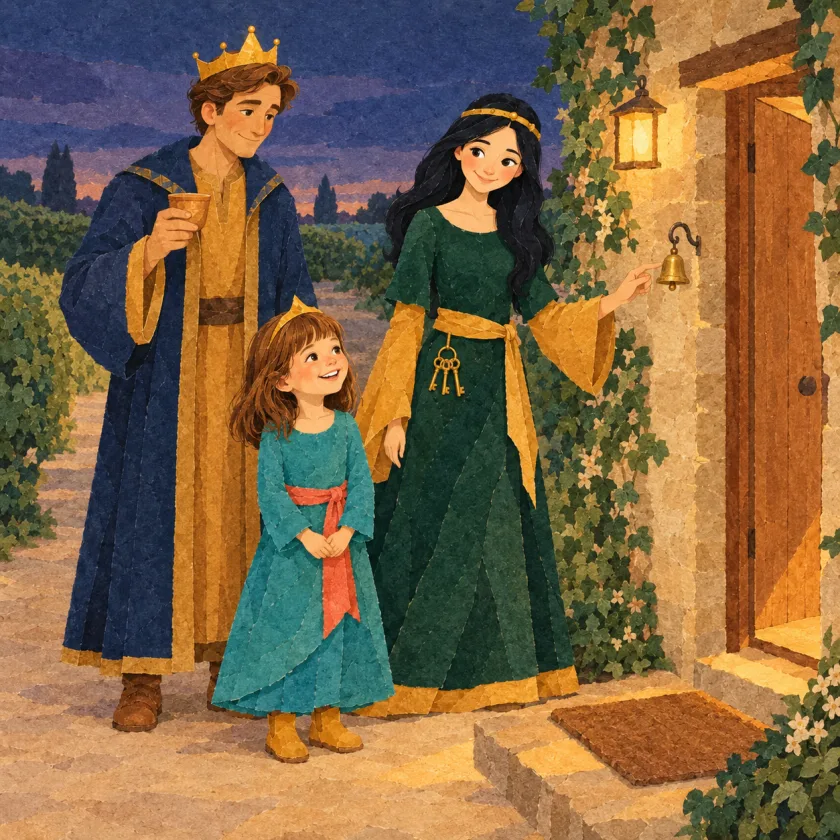
That night the small gold key hung by her bed on a coral ribbon.
Once in the night she put out her hand, and the key was there.